Review: In Deep — a Pulitzer reporter weighs the "deep state"
★★★★☆4.2 / 5.0 (editorial rating)
Verdict: the reporting that turns a slogan into evidence. Rohde interviews career FBI and CIA officers and walks fifty years of documented scandals to answer a plain question: where is there real, unaccountable power, and where is "deep state" just a rhetorical weapon? He resists both flattery and paranoia, which is precisely why it belongs right after Lofgren.
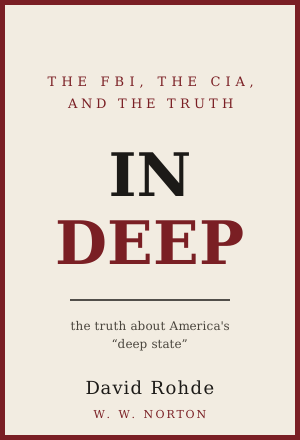
- Title
- In Deep: The FBI, the CIA, and the Truth about America's "Deep State"
- Author
- David Rohde (two-time Pulitzer Prize winner; national-security journalist)
- Publisher
- W. W. Norton & Company
- Length
- ~320 pp.
- Difficulty
- Intermediate ★★☆ — about eight hours
Check price & availability on the Amazon product page
What it is — in three lines
A work of narrative journalism by David Rohde, a two-time Pulitzer winner and veteran national-security reporter. Built on interviews with career intelligence and law-enforcement officers, it traces the FBI and CIA through a half-century of real controversies — and asks, case by case, whether the agencies were protecting the public trust or abusing it. The subtitle's "truth about America's deep state" is a promise to report, not to accuse.
The core — evidence against a slogan
Rohde's method is the antidote to loose talk. Rather than assert that a deep state does or does not exist, he assembles the record — the Church Committee's exposure of Cold War abuses, Iran-Contra, the false intelligence on Iraqi weapons, the NSA surveillance revealed by Snowden — and lets each episode show what unaccountable power has actually looked like, and where the "deep state" charge has been used as a political cudgel instead. The result is a careful sorting of genuine institutional danger from partisan myth.
The real question is not whether a shadow government secretly rules, but whether the visible agencies can be held to account — and the record cuts both ways.
— our editorial summary of Rohde's framing (not a direct quotation)
That even-handedness is why the book reads as reporting rather than argument, and why it makes such a strong second step.
Three highlights
1. Sources with standing
The interviews are with people who ran operations and investigations from the inside. That access gives the book authority a commentary from the outside could never have.
2. The scandals, in sequence
Laying the controversies end to end — Church Committee to Snowden — turns fifty years of separate headlines into a single, legible history of how oversight has and hasn't worked.
3. It refuses both comforting stories
Rohde neither exonerates the agencies nor indulges the fantasy of an all-powerful cabal. Holding that middle line under political pressure is the book's real achievement.
What to watch out for
Two notes. First, it is reporting, not a theory: if you want a single unifying analytical framework, that is Glennon's job, not Rohde's — this book gives you the cases and the judgments, not a general model. Second, it is U.S.-centric and current-affairs shaped, so some episodes assume a little background in recent American politics; if the names are unfamiliar, Lofgren's The Deep State sets the scene first. Read as evidence to weigh, not as the last word on any case.
Check price & availability on the Amazon product page