ANALYTIC PHILOSOPHY BOOK GUIDE
The 5 Best Analytic Philosophy Books (2026)
— from a modern introduction to the Tractatus, in reading order
Analytic philosophy has a reputation for being forbidding — logic, symbols, dry technical prose. In fact it is the tradition best suited to self-study. It does not build literary cathedrals; it examines language and argument one step at a time, so if you read in the right order, anyone can climb. There is only one reliable way to fail: starting with a primary text cold. Get the map from a modern introduction, trace the source, and only then take on the monument. Here are five books that won't defeat you.
The editorial room behind this site runs a family of philosopher bookshelves and a section-by-section reading archive of the primary texts — for example Heidegger's Being and Time (free, in Japanese). Every recommendation rests on first-hand reading and explicit bibliographic checking.
Our RankingRANKING
The editorial order. If you can't decide, start at #1. Check prices and availability on the Amazon product pages.
-
1
 If in doubt, start hereBeginner
Analytic Philosophy: A Very Short Introduction
The single best entry point: a slim, carefully built map of the tradition. Beaney — editor of the Oxford Handbook of the History of Analytic Philosophy — introduces Frege, Russell and Wittgenstein by working through real questions rather than reciting names, and shows that "analysis" is a creative craft you can practise. The map before the territory.
Check price & availability on Amazon / Kindle edition available
View on Amazon Read on Kindle Read our review -
2
 Beginner · classic
The Problems of Philosophy
"Is the table really there?" The source of the tradition, written in 1912 by one of its founders, begins from the most ordinary certainty and dismantles it — appearance and reality, perception, induction, universals, the limits of knowledge. The seeds of everything analytic philosophy later refined, in astonishingly plain prose.
Check price & availability on Amazon
View on Amazon Read our review -
3
 Intermediate
What Is Analytic Philosophy?
Once you have met the tradition, this is the book that asks what it even is. Glock — a German trained in Britain, teaching in Zurich — weighs every candidate definition (a doctrine? a method? a style? a lineage?) and settles on "family resemblance," while taking the analytic–continental divide seriously rather than scoring points. The map of the map.
Check price & availability on Amazon / Kindle edition available
View on Amazon Read on Kindle Read our review -
4
 Advanced
Analytic Philosophy: An Anthology (2nd ed.)
The papers themselves, in one volume. Instead of reading about Frege, Russell, Quine, Kripke and Davidson, you read the landmark essays — "On Denoting," "Two Dogmas of Empiricism," "Naming and Necessity" and dozens more — organised by topic. The reference shelf you dip into for the rest of your reading life.
Check price & availability on Amazon
View on Amazon Read our review -
5
 Advanced · primary
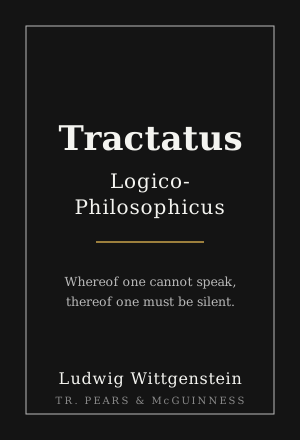
Tractatus Logico-Philosophicus (Routledge Classics)
"Whereof one cannot speak, thereof one must be silent." In a chain of numbered propositions, Wittgenstein draws the limits of language and world — the monument that shaped twentieth-century philosophy. The Pears–McGuinness translation, with Russell's introduction, is the standard English edition to attempt it in.
Check price & availability on Amazon / Kindle edition available
View on Amazon Read on Kindle Read our review
The 5 Books at a GlanceCOMPARE
The biggest worry with philosophy books is "can I actually read this?" Choose by difficulty and length.
| Title | Difficulty | Length | Type | Best for | Links |
|---|---|---|---|---|---|
| Analytic Philosophy: A Very Short IntroductionMichael Beaney · OUP | Beginner ★☆☆ | ~160 pp. ~4 hrs |
Modern introduction | You want the whole map before anything else | View on Amazon Review |
| The Problems of PhilosophyBertrand Russell · OUP | Beginner ★★☆ | ~176 pp. ~5 hrs |
Source classic (1912) | You want the tradition's starting point in the original | View on Amazon Review |
| What Is Analytic Philosophy?Hans-Johann Glock · Cambridge UP | Intermediate ★★☆ | ~292 pp. ~1 week |
Metaphilosophy | You want to know what the tradition actually is | View on Amazon Review |
| Analytic Philosophy: An Anthologyed. Martinich & Sosa · Blackwell | Advanced ★★★ | ~800 pp. reference |
Anthology of papers | You want the landmark essays in the original | View on Amazon Review |
| Tractatus Logico-PhilosophicusWittgenstein · Routledge Classics | Advanced ★★★ | ~142 pp. 1–2 weeks |
Primary text | You have the map and want the monument | View on Amazon Review |
A Reading Order That Won't Defeat YouROADMAP
The one reliable way to fail at analytic philosophy is opening a primary text cold. Get the map from a modern introduction, trace the source and see what the tradition is, and only then take on the monument. Climb in three steps.
-
STEP 1 ── Get the map (books 1–2)
Beaney's Very Short Introduction, then Russell's Problems of Philosophy
Beaney lays out what analytic philosophy does and who its founders were in about four hours. Russell then lets you feel the method at its source: start from "is the table really there?" and watch an ordinary certainty come apart. Together they give you the shape of the field and its founding move.
Beaney on AmazonRussell on Amazon -
STEP 2 ── What the tradition is, and its papers (books 3–4)
Glock's What Is Analytic Philosophy? for the definition, the Blackwell anthology for the primary essays
Glock steps back and asks what actually holds this movement together — a question that sharpens everything you have read so far. The Martinich–Sosa anthology then puts the landmark papers in your hands, so you meet Frege, Quine and Kripke in their own words rather than in summary. This is the step that turns points into a picture.
Glock on AmazonAnthology on Amazon -
STEP 3 ── The monument (the goal)
Take on the Tractatus
The book that set the tradition's course. The numbered propositions are hard, but after Steps 1–2 you read them knowing why this book matters so much — which is more than half the battle. The Pears–McGuinness translation, prefaced by Russell, is the standard companion for the ascent.
View on AmazonRead our review
How We ChoseCRITERIA
Three criteria. First, currently in print and actually available on amazon.com — every title has a live product page from an established publisher (Oxford, Cambridge, Wiley-Blackwell, Routledge). Second, the ladder must hold: modern introduction → source classic → what the tradition is and its primary papers → the monument, each step preparing the next, with entry points at every height from a 160-page introduction to a fully primary text. Third, honesty about what each book is: an introduction is scaffolding, an anthology is a reference, and the Tractatus is a primary text you attempt, not skim — and the reviews say so. Because the Japanese edition of this shelf leans on Japanese-language introductions (Aoyama, Yagisawa, Iida) with no English counterparts, this edition substitutes the closest respected English works — Beaney, Glock and the Blackwell anthology — while Russell and Wittgenstein carry straight over. The editorial room runs a family of philosopher bookshelves and a section-by-section archive of the primary texts (in Japanese); those first-hand readings are the foundation here.
Still Undecided? Take This OneCONCLUSION
If you have read this far and still can't choose, the answer is simple: buy Beaney's Analytic Philosophy: A Very Short Introduction. In one slim volume it hands you the map of the whole tradition — the founders, the questions, and the craft of analysis — for the price of an afternoon. Once you can feel that "this is a method I can use," the rest of the ladder climbs itself. If you would rather start from the source, open Russell's Problems of Philosophy instead.
Check price & availability on the Amazon product pages