Home › Top 5 › Analytic Philosophy: A Very Short Introduction
Review: Analytic Philosophy: A Very Short Introduction — the best first map of the tradition
★★★★★4.5 / 5.0 (editorial rating)
Verdict: the ideal first book, with almost nothing to argue about. In about 160 pages you get the founders, the central questions, and the feel of the method — and you get them from a leading historian of the tradition. Beaney's quiet insistence that analysis is a form of creativity, not just decomposition, is the single most useful idea a beginner can carry forward.
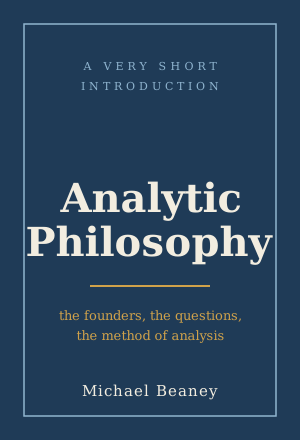
- Title
- Analytic Philosophy: A Very Short Introduction
- Author
- Michael Beaney
- Publisher
- Oxford University Press (Very Short Introductions)
- Length
- Modern introduction · ~160 pp.
- Difficulty
- Beginner ★☆☆ — reads in an afternoon
Check price & availability on the Amazon product page
What it is — in three lines
Michael Beaney is a historian of analytic philosophy — editor of the vast Oxford Handbook of the History of Analytic Philosophy — and here he compresses that expertise into one of Oxford's pocket-sized Very Short Introductions. Rather than march through a timeline of names, he opens with genuine philosophical questions and shows how the tools forged by Frege, Russell and the early Wittgenstein help answer them. It is a working demonstration of the method, not a catalogue of it.
Why it's the right first book
Most newcomers stall because they imagine analytic philosophy is a body of results to memorise. Beaney's book cures that. Its governing claim is that analysis is a creative act — you do not merely take a concept apart, you re-describe a problem until it becomes tractable. Seeing that in action, on small self-contained examples, is worth more than any list of doctrines, and it is exactly what lets a self-studying reader keep going.
Analysis is not just a matter of taking things apart; it is also, and more importantly, a matter of seeing connections and reconceiving a problem so that it can be solved.
— editorial paraphrase of Beaney's central theme
Because it is a Very Short Introduction, it never outstays its welcome; because it is by Beaney, it never dumbs the material down. That ratio of brevity to authority is rare.
Three highlights
1. Frege, made approachable
Frege is where analytic philosophy begins and where beginners most often drown. Beaney — a Frege scholar and translator — introduces the sense/reference distinction and the "linguistic turn" with the lightest touch that keeps them honest. If one chapter earns the price, it is this one.
2. Questions before names
Each idea arrives attached to a problem you can actually feel, so the machinery never floats free of a reason to care about it. This is the habit you want to build for everything you read next.
3. Analysis as creativity
The recurring theme — that good analysis reconceives a problem rather than just dissecting it — reframes the whole tradition as something you do, not something you are quizzed on. It is the idea most likely to survive in your head a year later.
What to watch out for
Two honest notes. First, "very short" means genuinely short: whole regions — later Wittgenstein, philosophy of mind, ethics in the analytic key — get a paragraph or a mention, not a chapter. This is a map, not the territory, and it is meant to be followed by fuller reading (which is what the rest of this shelf is for). Second, one or two passages move quickly through technical ground; if a page resists, read on and let the later examples light it up rather than stopping to master it. Nothing here needs to be mastered on first contact.
Check price & availability on the Amazon product page