Home › Top 5 › The Problems of Philosophy
Review: The Problems of Philosophy — analytic philosophy at its source
★★★★☆4.3 / 5.0 (editorial rating)
Verdict: the book that shows you where the tradition came from — in the original. It starts from the plainest certainty imaginable, "the table is there," and step by step makes your footing wobble, moving through appearance and reality, perception, induction, universals and the limits of knowledge. That it was written over a century ago and still reads this cleanly is the surprise.
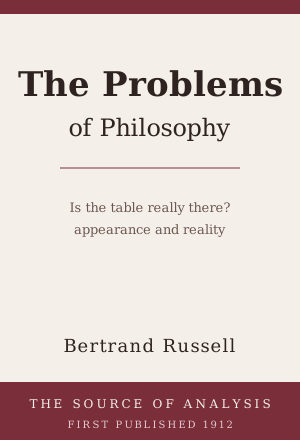
- Title
- The Problems of Philosophy
- Author
- Bertrand Russell (introduction by John Perry)
- Publisher
- Oxford University Press (original: 1912)
- Length
- Source classic · ~176 pp.
- Difficulty
- Beginner ★★☆ — plain prose, weighty ideas
Check price & availability on the Amazon product page
What it is — in three lines
Bertrand Russell — logician, co-author of Principia Mathematica, and one of the founders of analytic philosophy — wrote this short introduction in 1912, before the movement even had its name. It takes the recurring problems of modern philosophy (do things exist as they appear? what can we actually know?) and treats them with as little jargon as the subject allows. It is a founding figure's own map, drawn at the source.
The core — the art of doubting the obvious
The book's power is in the way it stops at something everyone takes for granted and refuses to move on. "There is a table in front of me" — yet what you actually have is colour, shape, hardness: sense-data, not the table itself. From this distinction between appearance and reality Russell builds outward to matter, idealism, induction and universals. The basic analytic gesture — draw the distinction, test the assumption — is here in its purest early form.
Is there any knowledge in the world which is so certain that no reasonable man could doubt it? This question, which at first sight might not seem difficult, is really one of the most difficult that can be asked.
— Bertrand Russell, The Problems of Philosophy, opening lines
You can read it straight through, and yet you close it holding sharper tools than most survey books hand over.
Three highlights
1. Appearance and reality (Chapter 1)
The opening chapter alone teaches you what it means to "see" philosophically. Is the table really there? Everything that follows rests on this unforgettable first move.
2. The problem of induction
Why are we entitled to say the sun will rise tomorrow? Russell's examination of how — or whether — past experience justifies claims about the future still cuts to the foundations of science.
3. On universals
Where does something like "whiteness" or "being to the left of" exist? The later chapters lead the reader into the heart of metaphysics by asking how things that are not particular objects can nonetheless be real.
A note on editions
Because the text was first published in 1912, it is in the public domain, and Amazon carries many cheap or free reprints of wildly varying quality — some with broken formatting or no apparatus at all. We link the Oxford University Press edition, with John Perry's introduction, precisely to steer you to a clean, well-set text from an established publisher. The words of the classic are the same in every edition; the reading experience is not. If you prefer, any reputable print edition will serve — the only mistake is a garbled scan.
Check price & availability on the Amazon product page