Home › Top 5 › What Is Analytic Philosophy?
Review: What Is Analytic Philosophy? — the definition, taken seriously
★★★★☆4.2 / 5.0 (editorial rating)
Verdict: the book that turns your scattered reading into a picture. Glock asks the deceptively simple question in the title and refuses every easy answer — not a single doctrine, not one method, not merely a style — before arriving at "family resemblance." Read it after you have met the tradition, and it retroactively organises everything you have taken in.
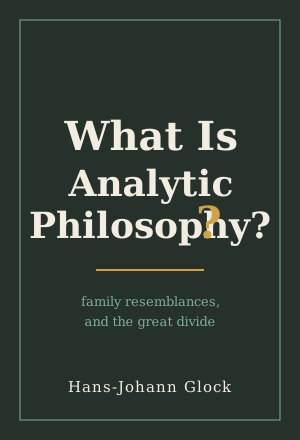
- Title
- What Is Analytic Philosophy?
- Author
- Hans-Johann Glock
- Publisher
- Cambridge University Press (2008)
- Length
- Metaphilosophy · ~292 pp.
- Difficulty
- Intermediate ★★☆ — argument-dense but lucid
Check price & availability on the Amazon product page
What it is — in three lines
Hans-Johann Glock — German by training, schooled in Britain, and a professor at Zurich — is unusually well placed to ask what analytic philosophy is, since he stands on both sides of the famous divide. His book surveys every candidate definition of the tradition and the methodological and historical problems each one raises, then defends a considered answer. It is metaphilosophy: philosophy about the shape of philosophy itself.
The core — why no single definition works
Ask what unites Frege, Russell, Wittgenstein, Carnap, Quine and Kripke and every neat answer fails. A shared doctrine? They contradict one another. A single method? It keeps changing. Glock's move is to borrow Wittgenstein's own idea: analytic philosophy is a family-resemblance concept, a movement held together by overlapping similarities and ties of historical influence rather than one defining essence. It is a genuinely satisfying resolution to a question that trips up most newcomers.
Analytic philosophy is a tradition held together both by ties of mutual influence and by family resemblances — not by a single doctrine or method that all its members share.
— editorial paraphrase of Glock's central thesis
The payoff is orientation: once you see the tradition this way, you stop looking for a creed and start seeing a conversation.
Three highlights
1. The candidate definitions, weighed one by one
Glock lines up the usual answers — analytic philosophy as logic, as language, as science-friendly, as anti-metaphysical — and shows exactly where each holds and where it breaks. Watching a good philosopher test definitions is itself an education in the method.
2. The analytic–continental divide, without tribalism
Because he belongs to both worlds, Glock treats the divide as a real intellectual question rather than an excuse for point-scoring. His even-handedness is rare and clarifying.
3. History used as evidence
The argument is threaded through the actual history of the movement, so you leave with a firmer sense of who influenced whom — a timeline you can hang your later reading on.
What to watch out for
Two honest notes. First, this is not an introduction to the ideas — Glock assumes you already have some acquaintance with the figures he discusses, which is exactly why it sits at Step 2 here rather than first. Read it before Beaney and it will feel like answers to questions you have not yet asked. Second, the prose is dense with argument; it rewards slow reading and note-taking more than a single sitting. Come to it after the map, and its lucidity carries you.
Check price & availability on the Amazon product page