Home › Top 5 › Tractatus Logico-Philosophicus
Review: Tractatus Logico-Philosophicus — the monument, attempted in the right order
★★★★★4.6 / 5.0 (editorial rating)
Verdict: the primary text the whole shelf climbs toward. In a lattice of numbered propositions Wittgenstein maps the limits of language and world, and then — famously — turns that map against philosophy itself and demands silence. Hard, yes; but attempted after the introductions, with the Pears–McGuinness translation and Russell's preface as guides, it is one of the most electrifying short books ever written.
- Title
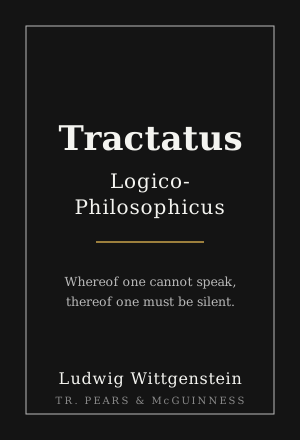
- Tractatus Logico-Philosophicus (Routledge Classics)
- Author
- Ludwig Wittgenstein, tr. D. F. Pears & B. F. McGuinness
- Publisher
- Routledge (original: 1921; this translation 1961)
- Length
- Primary text · ~142 pp. (with Russell's introduction)
- Difficulty
- Advanced ★★★ — read slowly, proposition by proposition
Check price & availability on the Amazon product page
What it is — in three lines
The only book-length work Wittgenstein published in his lifetime, the Tractatus (1921) sets out to say what can be said and to show that the rest — ethics, the mystical, the sense of the world — can only be shown, not stated. Its argument is delivered in seven numbered propositions with decimally numbered remarks nested beneath them, a structure built to be climbed like a proof. This Routledge Classics edition uses the standard Pears–McGuinness translation and opens with Russell's introduction.
The core — a book built like a proof
The Tractatus advances a "picture theory" of meaning: a proposition has sense because it pictures a possible arrangement of things in the world. Push that thought to its limit and a startling consequence follows — the deepest questions of philosophy are not false but senseless, because they try to say what language can only show. Hence the last proposition, at once modest and shattering:
Whereof one cannot speak, thereof one must be silent.
— Ludwig Wittgenstein, Tractatus 7 (Pears–McGuinness render the same line: "What we cannot speak about we must pass over in silence.")
Few books have so small a page count and so large a shadow; the Vienna Circle, logical positivism and much of what followed grew in argument with it.
Three highlights
1. The numbering system
The decimal scaffolding (1, 1.1, 1.11 …) is not decoration — it tells you which remarks are load-bearing and which are elaborations. Reading the whole-number propositions first, then descending, is a legitimate way in.
2. The picture theory of meaning
The idea that a sentence models reality the way a picture does is the engine of the book, and one of the most influential proposals in the philosophy of language.
3. The closing turn to silence
That the book ends by declaring much of philosophy unsayable — and even calls its own propositions a ladder to be thrown away — is the move that has fascinated readers for a century. It is worth the climb to reach it knowingly.
What to watch out for
Two honest notes. First — and this is the whole reason it sits at #5 — do not start here. Opening the Tractatus cold is the classic way to be defeated by analytic philosophy; read after Beaney, Russell, Glock and the anthology, the same propositions become legible. Second, several English editions exist: the older Ogden translation (also with Russell's introduction) is fine and often cheaper, but we link the Pears–McGuinness version as the modern scholarly standard. Whichever you choose, read it slowly, and treat a good secondary commentary as a companion rather than a crutch.
Check price & availability on the Amazon product page