NISHIDA KITARO BOOK GUIDE
The 5 Best Nishida Kitarō Books (2026)
— from An Inquiry into the Good to a philosophy of nothingness, in reading order
Nishida Kitarō (1870–1945) is often called the first original philosopher Japan produced, and the founder of the Kyoto School. Many readers know the name of his debut, An Inquiry into the Good, yet freeze in front of the words "pure experience," "place" (basho), and "absolute nothingness." There is a staircase you can actually climb. Begin with a clear introduction, add an intellectual biography and the wider Kyoto School context, then read his masterwork in his own words, and finish with the last essay he wrote. Five books, arranged by readability and by the order in which they build.
The editorial room behind this site runs a family of philosopher bookshelves and a section-by-section reading archive of the primary texts (in Japanese). Every recommendation rests on first-hand reading, and every page here is honest about one fact: Nishida wrote in Japanese, so in English you meet him through translators and interpreters — and we say which is which. See also the Japanese edition of this shelf.
Our RankingRANKING
The editorial order. If you can't decide, start at #1. Check prices and availability on the Amazon product pages.
-
1
 If in doubt, start hereBeginner
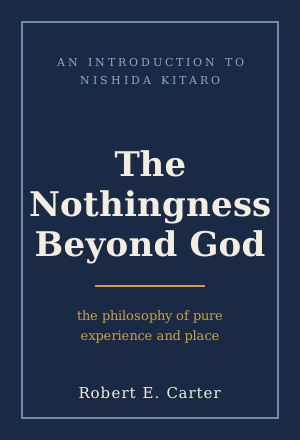
The Nothingness Beyond God: An Introduction to the Philosophy of Nishida Kitaro
The most approachable single door into Nishida in English. Carter walks through the key ideas — pure experience, the logic of basho ("place"), and the "nothingness" that is not mere absence — in ordinary, patient prose, so that the vocabulary stops being a wall. Read this first and everything else gets easier.
Check price & availability on Amazon
View on Amazon Read our review -
2
 Beginner–Intermediate
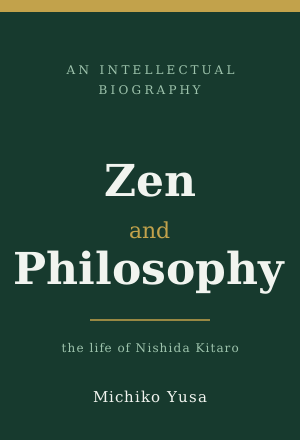
Zen and Philosophy: An Intellectual Biography of Nishida Kitaro
The definitive life in English. Yusa follows Nishida from his Zen practice and personal losses to the philosophy each period produced, so that "pure experience," "place," and "absolute contradictory self-identity" arrive as answers to lived questions rather than as jargon. Long, but eminently readable — the biography that gives the whole map.
Check price & availability on Amazon / Kindle edition available
View on Amazon Read on Kindle Read our review -
3
 Intermediate
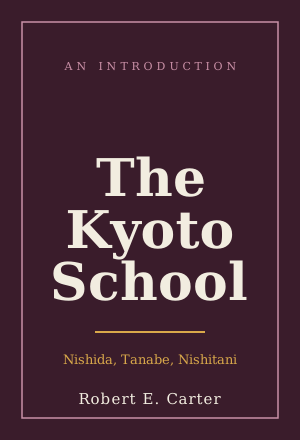
The Kyoto School: An Introduction
Nishida founded a school, and his ideas are best understood alongside those who extended them. Carter introduces Nishida, Tanabe, Nishitani and others in turn, showing how "nothingness" became a shared philosophical project. The context book: read it to see where Nishida sits and what he set in motion.
Check price & availability on Amazon / Kindle edition available
View on Amazon Read on Kindle Read our review -
4
 Intermediate–Advanced (the masterwork)
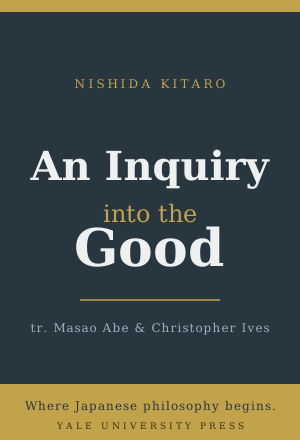
An Inquiry into the Good
Nishida's debut and masterwork (Zen no kenkyū, 1911), in the standard English translation. From a single starting point — "pure experience," prior to the split of subject and object — he drives through reality, the good, and religion. The origin of modern Japanese philosophy, in his own words.
Check price & availability on Amazon / Kindle edition available
View on Amazon Read on Kindle Read our review -
5
 Advanced
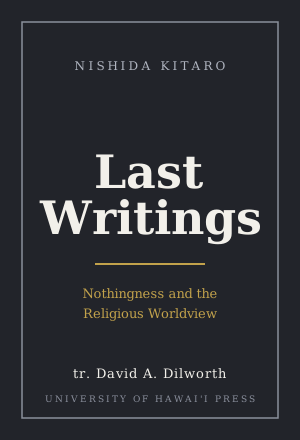
Last Writings: Nothingness and the Religious Worldview
The final essay, completed weeks before his death in 1945, with Dilworth's translation and a substantial introduction. Here the mature logic of basho and "absolute nothingness" turns to religion and the self. The advanced destination — the most concentrated Nishida, best reached after the earlier steps.
Check price & availability on Amazon
View on Amazon Read our review
The 5 Books at a GlanceCOMPARE
The biggest worry with Nishida is "can I keep up with that vocabulary?" Choose by difficulty and by type — introduction, biography, context, or primary text.
| Title | Difficulty | Length | Type | Best for | Links |
|---|---|---|---|---|---|
| The Nothingness Beyond GodRobert E. Carter · Paragon House | Beginner ★☆☆ | ~256 pp. | Introduction | First contact; you want the ideas in plain prose | View on Amazon Review |
| Zen and PhilosophyMichiko Yusa · Univ. of Hawai'i Press | Beginner–Intermediate ★★☆ | ~510 pp. | Intellectual biography | You want the life and the thought as one story | View on Amazon Review |
| The Kyoto School: An IntroductionRobert E. Carter · SUNY Press | Intermediate ★★☆ | ~258 pp. | Context / school | You want to place Nishida among his successors | View on Amazon Review |
| An Inquiry into the Goodtr. Abe & Ives · Yale University Press | Intermediate–Advanced ★★★ | ~220 pp. | Primary (the masterwork) | You want Nishida's debut in his own words | View on Amazon Review |
| Last Writingstr. Dilworth · Univ. of Hawai'i Press | Advanced ★★★ | ~155 pp. | Primary (late essay) | You want the mature Nishida, argument by argument | View on Amazon Review |
A Reading Order That Won't Defeat YouROADMAP
Most people stall on Nishida for two reasons: opening a primary text cold, and trying to memorize "pure experience" and "place" as dictionary definitions. A plain introduction → the life and the school → the masterwork → the final essay. Climb in four steps.
-
STEP 1 ── Get your bearings (one book)
Read Carter's Nothingness Beyond God for the vocabulary
Don't dive into a primary text first. Let Carter introduce pure experience, basho, and "nothingness" in plain prose, so the words become ideas you can hold rather than a wall you bounce off.
The Introduction on Amazon -
STEP 2 ── Build the scaffolding (books 2–3)
Yusa's biography for the life, Carter's Kyoto School for the context
Yusa's Zen and Philosophy shows where each idea came from in Nishida's own life; The Kyoto School shows where those ideas went next. With the life and the school in view, you won't get lost inside the primary text.
The Biography on AmazonThe Kyoto School on Amazon -
STEP 3 ── Read the masterwork
Take on An Inquiry into the Good in his own words
Now read the debut that started it all: from pure experience through reality, the good, and religion, driven by a single principle. With the introduction and biography behind you, the same sentences read astonishingly better. This is the one-book success that unlocks the rest.
An Inquiry into the Good on Amazon -
STEP 4 ── The late Nishida (the goal)
Finish with Last Writings
Once you've read the masterwork, meet the mature logic of "place" and "absolute nothingness" in the essay Nishida completed just before his death. Dilworth's introduction carries you through. Reach this, and the shelf has done its job.
Last Writings on AmazonRead our review
How We ChoseCRITERIA
Three criteria. First, currently in print and actually available on amazon.com — every title has a live product page from an established academic publisher (Yale, University of Hawai'i Press, SUNY, Paragon House). Second, the ladder must hold: introduction → life and school → masterwork → final essay, each step preparing the next, with entry points at every height from a plain-prose guide to a fully annotated primary text. Third, honesty about what each book is: Nishida wrote in Japanese, so in English you meet him through translators (Abe & Ives, Dilworth) and interpreters (Carter, Yusa) — a study is scaffolding, a translation is the thing itself, and the reviews say which. The Japanese edition of this shelf recommends the Japanese originals and annotated editions; this English edition substitutes the closest respected English-language works, and the About page explains the mapping.
Still Undecided? Take This OneCONCLUSION
If you have read this far and still can't choose, start with Carter's The Nothingness Beyond God. It is the one book that makes every other title on this shelf easier: pure experience, "place," and "nothingness" laid out in plain prose, so that when you reach An Inquiry into the Good the vocabulary is already yours. Read the introduction first, then the masterwork — that is the recommended route.
Check price & availability on the Amazon product pages