Home › Top 5 › Zen and Philosophy
Review: Zen and Philosophy — the definitive life of Nishida in English
★★★★★4.6 / 5.0 (editorial rating)
Verdict: read this once, and the terminology stops being terminology. Yusa's long, humane biography ties every hard idea — pure experience, "place," "absolute contradictory self-identity" — back to the Zen practice, the bereavements, and the reading that produced it. It is the map that makes the primary texts navigable, and one of the best philosopher biographies of recent decades.
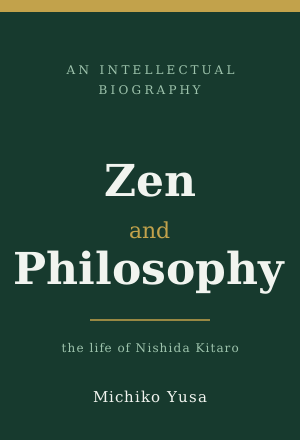
- Title
- Zen and Philosophy: An Intellectual Biography of Nishida Kitaro
- Author
- Michiko Yusa (Japanese thought, Western Washington University)
- Publisher
- University of Hawai'i Press (2002)
- Length
- ~510 pp.
- Difficulty
- Beginner–Intermediate ★★☆ — long but readable
Check price & availability on the Amazon product page
What it is — in three lines
A full-scale intellectual biography of Nishida Kitarō (1870–1945) by Michiko Yusa, drawing on his letters, diaries, and the whole arc of his career. It narrates the life and the philosophy together: the Zen training of his youth, the teaching years in Kyoto, the deaths of children and his wife, and the successive breakthroughs from An Inquiry into the Good to the late logic of "place."
The core — a life becomes a logic
Nishida's concepts read as cold abstractions until you know what pressed them into being. Yusa's achievement is to show the philosophy growing out of the life without reducing one to the other. His years of Zen practice stand behind "pure experience"; his grief and his sense of the self's fragility stand behind the later meditations on nothingness and the religious. You finish understanding not just what Nishida claimed but why these were the questions he could not put down.
To understand a philosophy of pure experience, it helps to know a man who had sat, in silence, with experience itself.
— editorial gloss on Yusa's approach
That is the value of the book: the vocabulary you met in the introduction now has a biography, and so a meaning you can feel.
Three highlights
1. Sources you can trust
Yusa works from Nishida's own letters and journals, and her scholarship is meticulous. This is the reference-grade life, not a popular sketch.
2. Zen and philosophy, held together
The title's two words are the book's argument: it shows precisely how a Zen sensibility and rigorous Western-trained philosophy meet in one thinker, without collapsing either.
3. Readable at length
It is five hundred pages, but narrative pages — the story carries you, and the ideas arrive on the crest of events rather than in a lecture.
What to watch out for
Two honest notes. First, it is a biography, not a systematic exposition. If you want the arguments set out step by step in the abstract, that job belongs to Carter's introduction and to the primary texts themselves; Yusa gives you the human and historical current they run in. Second, the length is real — treat it as a book to live with over a week or two, not an afternoon. Read it after the introduction, while the vocabulary is fresh.
Check price & availability on the Amazon product page