Home › Top 5 › The Kyoto School
Review: The Kyoto School: An Introduction — where Nishida's ideas went next
★★★★☆4.2 / 5.0 (editorial rating)
Verdict: Nishida did not think alone, and this is the book that shows the company he kept. Carter introduces Nishida, Tanabe, Nishitani and their successors in turn, so you see "nothingness" grow from one man's idea into a school's shared project. Read it to place Nishida — to understand both what he inherited and what he started.
- Title
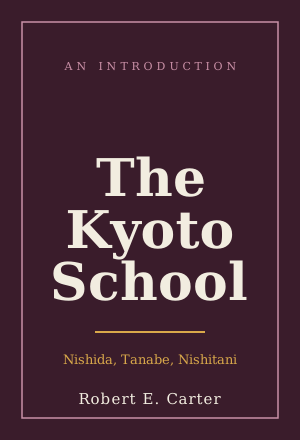
- The Kyoto School: An Introduction
- Author
- Robert E. Carter (foreword by Thomas P. Kasulis)
- Publisher
- SUNY Press (State University of New York Press, 2013)
- Length
- ~258 pp.
- Difficulty
- Intermediate ★★☆ — clear, but assumes some Nishida
Check price & availability on the Amazon product page
What it is — in three lines
An accessible survey of the Kyoto School, the tradition of philosophy that grew up around Nishida at Kyoto University in the twentieth century. Carter devotes chapters to Nishida, Tanabe Hajime, Nishitani Keiji and later figures, with a foreword by Thomas P. Kasulis. Its subject is not one book but a lineage of thought centred on nothingness, self, and the absolute.
The core — one idea, four thinkers
Read on its own, Nishida can look like a solitary eccentric. Placed in this book, he becomes a founder: the person who put "absolute nothingness" on the table, after which Tanabe pressed it toward a "logic of species" and social critique, and Nishitani carried it into a confrontation with nihilism and religion. Carter's structure — thinker by thinker — lets you watch a single problem passed from hand to hand and reshaped each time. You come away seeing Nishida's ideas not as endpoints but as openings.
A school is an argument extended across a generation; Nishida wrote the first premise.
— editorial gloss on the book's structure
That is the value of the book: it converts Nishida from an isolated difficulty into the origin of a conversation.
Three highlights
1. Clear thinker-by-thinker chapters
Each major figure gets a self-contained, readable chapter, so you can meet Tanabe or Nishitani without first mastering everything before them.
2. Nishida in context
Seeing what his successors kept, dropped, and criticized is one of the fastest ways to grasp what was distinctive in Nishida himself.
3. A responsible foreword and apparatus
Kasulis's foreword and Carter's framing set the school in its historical and ethical setting — including the fraught wartime questions the tradition raises — without turning the book into a polemic.
What to watch out for
Two honest notes. First, it is breadth, not depth on Nishida alone. Because it covers a whole school, its Nishida chapter is a portrait, not the full study — pair it with Carter's dedicated introduction and the primary texts. Second, it reads best after you already have some Nishida in hand; opened cold, the comparisons between thinkers will not yet mean much. Introduction and biography first, this third.
Check price & availability on the Amazon product page