Home › Top 5 › An Inquiry into the Good
Review: An Inquiry into the Good — where Japanese philosophy begins
★★★★★5 / 5.0 (editorial rating)
Verdict: the masterwork, read in Nishida's own words. From one starting point — "pure experience," prior to the split of subject and object — he drives through reality, the good, and religion with a single principle. It is dense, but with the introduction, the biography, and the school behind you, the same sentences turn from a wall into the most rewarding climb on this shelf. The book modern Japanese philosophy starts from.
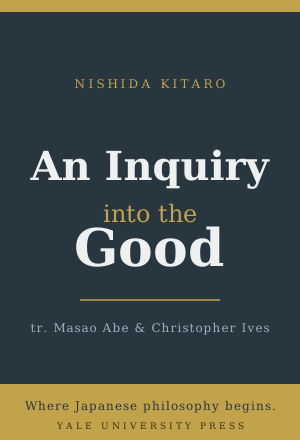
- Title
- An Inquiry into the Good (Zen no kenkyū, 1911)
- Author
- Nishida Kitaro
- Translators
- Masao Abe & Christopher Ives
- Publisher
- Yale University Press
- Length
- ~220 pp.
- Difficulty
- Intermediate–Advanced ★★★ — the masterwork
Check price & availability on the Amazon product page
What it is — in three lines
An Inquiry into the Good (Zen no kenkyū) is the book Nishida published in 1911, and the first work of original philosophy written by a Japanese thinker. It takes "pure experience" — direct experience before the division into subject and object — as the one reality, and from there builds outward into a theory of reality, an ethics of the good, and a philosophy of religion. This Yale University Press edition is the standard English translation, by Masao Abe and Christopher Ives.
The core — one principle, all the way through
What makes the book astonishing is its unity: from a single starting point, Nishida reasons through the largest questions without changing footing. We normally assume there is first an "I" (subject) that then experiences a "world" (object). Nishida inverts this — the immediate experience prior to that split is the ground, and self and world are later distinctions drawn within it. From that inversion follow his distinctive conclusions: the good is the realization of the self's true demand, and religion is the union of self and reality. Short, concentrated, every sentence load-bearing — which is exactly why the earlier steps on this shelf pay off here.
Experience does not exist because there is an individual; an individual exists because there is experience.
— the widely cited formula from Nishida's Preface (editorial rendering)
That is the value of the book: you watch experience, reality, the good, and religion drawn out of one root, in the philosopher's own hand.
Three highlights
1. A single idea carried to its limit
Pure experience is followed relentlessly from metaphysics to ethics to religion — the architecture is the achievement, and you feel it build.
2. The origin point of a tradition
Read this and you stand at the source of the Kyoto School and of modern Japanese philosophy — everything downstream refers back here.
3. A translation with apparatus
The Abe & Ives edition comes with an introduction that situates the work, so you are not left alone with the barest text.
What to watch out for
Two honest notes. First, do not make it your first book. Its brevity is deceptive: the compression that rewards a prepared reader will defeat a cold one. Read Carter's introduction and Yusa's biography first, and this becomes readable. Second, do not try to seize every argument on one pass — follow the spine of "pure experience" through the whole, get the shape of the movement, and let the details settle on a second reading. That is how a "difficult book" becomes a "concentrated classic."
Check price & availability on the Amazon product page