Review: Last Writings — nothingness and the religious worldview
★★★★☆4.4 / 5.0 (editorial rating)
Verdict: the mature Nishida, at his most concentrated. This is the essay he finished only weeks before he died in 1945, where the late logic of "place" (basho) and "absolute nothingness" is turned toward religion, the self, and God. Dilworth's long introduction carries you in. The advanced destination of this shelf — demanding, but the culmination the earlier steps were preparing you for.
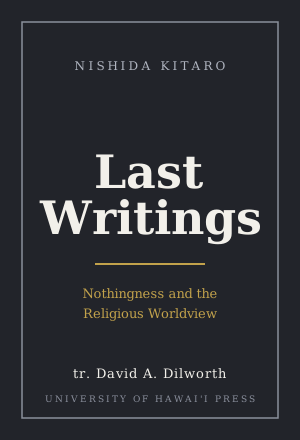
- Title
- Last Writings: Nothingness and the Religious Worldview
- Author
- Nishida Kitaro
- Translator
- David A. Dilworth (with an introduction)
- Publisher
- University of Hawai'i Press
- Length
- ~155 pp.
- Difficulty
- Advanced ★★★ — the concentrated late Nishida
Check price & availability on the Amazon product page
What it is — in three lines
This volume presents "The Logic of Place and the Religious Worldview," the essay Nishida completed in 1945, just before his death, together with a shorter related piece and a substantial introduction by the translator, David A. Dilworth. It is the last statement of his philosophy: the mature logic of basho and absolute nothingness brought to bear on religion, the self, and the absolute. University of Hawai'i Press.
The core — the logic of place, turned to religion
By the end of his life, Nishida no longer began from "pure experience" but from "place" (basho) — the idea that whatever is, is only as determined within a field, and that the deepest such field is "absolute nothingness." In this final essay he asks what religion looks like from there: not belief in an object called God, but the self's relation to the absolute that grounds and negates it. The famous formulations — the self as "absolutely contradictory self-identity," the "inverse correspondence" between the self and the absolute — reach their last and densest form here. It is Nishida thinking at the edge of what language will carry.
The religious relation is not the self grasping the absolute, but the self meeting the absolute precisely where it is negated.
— editorial gloss on Nishida's "inverse correspondence"
That is the value of the book: you meet Nishida's lifelong questions in their final, hardest, and most personal form.
Three highlights
1. The philosophy's last word
Written at the very end, it shows where a lifetime of thinking about experience, place, and nothingness finally arrived — a genuine summation.
2. Dilworth's introduction
The translator's long introductory essay is real scaffolding, mapping the terminology and the stakes before you enter the primary text.
3. Religion without a fixed God
The essay's account of the religious — self and absolute in "inverse correspondence" — is among the most distinctive things in modern philosophy of religion, East or West.
What to watch out for
Two honest notes. First, this is the deep end. The late vocabulary is the most compressed Nishida wrote; do not start here. Come to it after An Inquiry into the Good, with the introduction and the biography already behind you. Second, lean on Dilworth's introduction and read slowly — a few pages at a sitting, tracing "place" and "nothingness" rather than chasing every clause. Treated that way, the essay rewards the climb; rushed, it will simply blur.
Check price & availability on the Amazon product page