Home › Top 5 › The Nothingness Beyond God
Review: The Nothingness Beyond God — the plainest door into Nishida
★★★★☆4.3 / 5.0 (editorial rating)
Verdict: the book to hand someone who has bounced off Nishida once already. Carter takes the three words that stop most readers — pure experience, "place" (basho), and "nothingness" — and explains them in ordinary, unhurried prose, so they become ideas you can hold instead of a wall you slide down. Read this first, and every other title on this shelf gets easier.
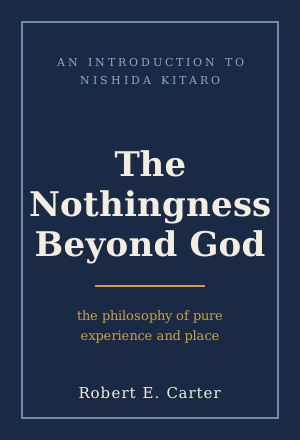
- Title
- The Nothingness Beyond God: An Introduction to the Philosophy of Nishida Kitaro
- Author
- Robert E. Carter (philosophy, Trent University)
- Publisher
- Paragon House (2nd edition)
- Length
- ~256 pp.
- Difficulty
- Beginner ★☆☆ — the accessible first book
Check price & availability on the Amazon product page
What it is — in three lines
A book-length introduction to Nishida's philosophy by Robert E. Carter, a philosopher who has written and translated widely on Japanese thought. Not a biography and not a primary text, but a guided tour of the ideas: pure experience, the logic of basho ("place"), self and the absolute, and the ethics and religion that follow. Written for readers who bring no Japanese and no prior Nishida.
The core — "nothingness" is not nothing
The single hardest hurdle for a Western reader is the word "nothingness." It sounds like a void, a nihilism, an absence — and Nishida means almost the opposite. Carter's central service is to slow down on exactly this point: "absolute nothingness" is not the lack of things but the placeless "place" in which things and experiences arise, the ground that cannot itself be made an object. The book's title names the wager — that this nothingness lies "beyond God" as usually conceived — and Carter unfolds it patiently rather than assuming you already share it.
The nothingness of Nishida is not an empty void but the field in which every "something" comes to be.
— editorial gloss of Carter's guiding theme
That is the value of the book: the word that would have defeated you in a primary text is disarmed in advance.
Three highlights
1. Vocabulary, made usable
Pure experience, basho, self-identity, the absolute — each term is introduced with everyday examples before the technical weight is added. You leave holding working definitions, not memorized labels.
2. Ideas before names
Carter foregrounds the problems Nishida was trying to solve, so the strange terminology reads as a set of answers. That reframing is what makes the primary texts survivable later.
3. Toward ethics and religion
The later chapters carry the metaphysics into how one should live and what religion means — the same arc An Inquiry into the Good travels, previewed in plainer language.
What to watch out for
Two honest notes. First, it is an interpretation, not neutral ground. Carter reads Nishida through a particular emphasis on nothingness and religion; it is a responsible reading, but it is a reading, and other scholars weight the logic of basho differently. Second, this is a study about Nishida, not Nishida himself — do not let it substitute for An Inquiry into the Good. Use it as the map that gets you to the primary text, then go read the primary text.
Check price & availability on the Amazon product page