MOZI BOOK GUIDE
The 5 Best Mozi (Mo Tzu) Books (2026)
— from Basic Writings to the complete translation, in reading order
"It is the business of the benevolent man to seek to promote what is beneficial to the world and to eliminate what is harmful." Mozi (Mo Tzu, 5th century B.C.) taught universal love — care for everyone without partiality — and drew from it a hard-headed case against aggressive war and against waste. He was Confucianism's first great rival, and, some argue, the world's first consequentialist. But English readers hit a wall at the start: is the door a short selection, an anthology, the 944-page complete text, or a scholarly study? There is an order that works. An accessible selection, then the map of the whole tradition, then more of the primary text, then a modern study. Five real books, in reading order.
The editorial room behind this site runs a family of philosopher bookshelves — for example The Philosophy Bookshelf and Socrates — and a section-by-section reading archive of the primary texts (in Japanese). Every recommendation rests on first-hand reading, and every page here is honest about one fact: Mozi's doctrines are simple to state and radical to follow, and the short door in is the right one.
Our RankingRANKING
The editorial order. If you can't decide, start at #1. Check prices and availability on the Amazon product pages.
-
1
 If in doubt, start hereBeginner
Mozi: Basic Writings
The best entry point: a slim, readable selection of the core chapters — "Universal Love," "Against Offensive Warfare," "Moderation in Expenditure," "Against Music," "Anti-Fatalism" — from one of the world's most trusted translators of Chinese. Short enough to read in an afternoon, it gives you Mozi's whole argument in his own words before you commit to anything longer.
Check price & availability on Amazon
View on Amazon Read our review -
2
 BeginnerBest for context
Introduction to Classical Chinese Philosophy
A lucid modern guide to the whole Warring States debate, with a dedicated chapter on Mohism. Van Norden shows why Mozi's universal love was so provocative to Confucians and how his rivals answered it — the context that turns a list of doctrines into a live argument. The secondary book to read alongside the selection, so Mozi stops being a name and becomes a position.
Check price & availability on Amazon
View on Amazon Read our review -
3
 IntermediateKindle available
Readings in Classical Chinese Philosophy
The standard teaching anthology: substantial Mozi selections set beside Kongzi (Confucius), Mengzi, Zhuangzi, Xunzi, and Han Feizi, so you read Mohism as one voice in a real conversation. Excellent introductions and notes to each thinker. If the Watson selection leaves you wanting more of the primary text — but not yet all 944 pages — this is the next step.
Check price & availability on Amazon / Kindle edition available
View on Amazon Read on Kindle Read our review -
4
 Advanced
The Mozi: A Complete Translation
The whole book, at last: Ian Johnston's complete, annotated, bilingual translation — the first in a European language to give every chapter, including the difficult "Dialectical" (Mohist Canon) chapters on logic, language, and optics that the selections leave out. Long and scholarly, but this is where the Mohist system opens out in full. The reference edition to own once the core has you hooked.
Check price & availability on Amazon
View on Amazon Read our review -
5
 AdvancedKindle available
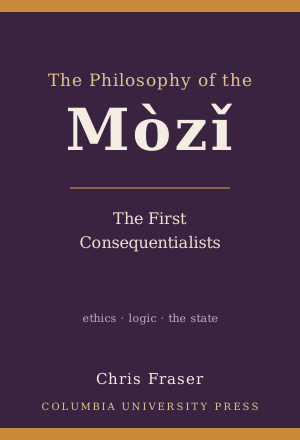
The Philosophy of the Mòzǐ: The First Consequentialists
The best modern study in English. Fraser reconstructs Mohism as a coherent philosophy — its ethics, political theory, epistemology, logic, and psychology — and makes the case that the Mohists were the first consequentialists. Reach it after the primary texts and you will see why this "minor" school matters to ethics and philosophy of language far beyond China. A demanding, rewarding finish.
Check price & availability on Amazon / Kindle edition available
View on Amazon Read on Kindle Read our review
The 5 Books at a GlanceCOMPARE
The biggest worry with Mozi is "which door in?" — a short selection, an anthology, the complete text, or a study. Choose by difficulty and by type. You do not need all five: one accessible primary and one guide already take you a long way.
| Title | Difficulty | Length | Type | Best for | Links |
|---|---|---|---|---|---|
| Mozi: Basic Writingstr. Watson · Columbia | Beginner ★☆☆ | ~140 pp. ~3 hrs |
Primary (accessible selection) | First contact; the core doctrines in his words | View on Amazon Review |
| Introduction to Classical Chinese PhilosophyVan Norden · Hackett | Beginner ★☆☆ | ~304 pp. ~8 hrs |
Introduction (context) | Seeing why Mozi mattered to his rivals | View on Amazon Review |
| Readings in Classical Chinese Philosophyed. Ivanhoe & Van Norden · Hackett | Intermediate ★★☆ | ~416 pp. a few weeks |
Primary anthology (in context) | More Mozi, beside the other schools | View on Amazon Review |
| The Mozi: A Complete Translationtr. Johnston · Columbia | Advanced ★★★ | ~944 pp. a project |
Primary (complete) | The whole text, including the Dialectical chapters | View on Amazon Review |
| The Philosophy of the MòzǐFraser · Columbia | Advanced ★★★ | ~408 pp. 1–2 weeks |
Study (a modern reading) | Mohism as the first consequentialism | View on Amazon Review |
A Reading Order That Won't Defeat YouROADMAP
People bounce off Mozi for two reasons: opening with the 944-page complete translation, and trying to memorise "universal love," "against aggression," and "conforming upward" before meeting the arguments that give them force. Accessible selection → the map of the tradition → more primary text → a modern study. Climb in four steps.
-
STEP 1 ── Get the core (one book)
Read Watson's Basic Writings
Don't open the complete text yet. Watson's slim selection gives you the heart of Mozi in an afternoon — universal love, the argument against offensive war, moderation in expenditure, the attack on fatalism. The point is to meet the doctrines in Mozi's own voice before anyone explains them to you.
Watson's Basic Writings on Amazon -
STEP 2 ── Get the map (parallel is fine)
Read Van Norden's Introduction for the context
Now situate him. Van Norden's Introduction to Classical Chinese Philosophy sets Mohism against the Confucians and the Daoists and shows why "love everyone equally" was a scandal, not a platitude. Read the Mohism chapter alongside the selection and the doctrines snap into a live debate. You can do this in parallel with Step 1.
Van Norden's Introduction on Amazon -
STEP 3 ── More of the primary text
Go wider with the Readings anthology — or all the way with Johnston
Ready for more Mozi in the original? The Readings anthology gives you fuller selections beside the rival schools; the Johnston Complete Translation gives you every chapter, including the technical "Dialectical" ones on logic and language. Take the anthology if you want breadth across the tradition, the complete text if you want Mozi entire.
The Readings anthology on AmazonJohnston's Complete Translation on Amazon -
STEP 4 ── A modern study (the goal)
Fraser's The Philosophy of the Mòzǐ
Finish with the best modern reconstruction. Fraser draws the ethics, politics, epistemology, and logic into one system and argues the Mohists were the first consequentialists. Reach it after the originals and you are watching an ancient school rejoin live debates in ethics and philosophy of language — which is where this shelf was always heading.
Fraser's study on AmazonRead on Kindle
How We ChoseCRITERIA
Three criteria. First, currently in print and actually available on amazon.com — every title has a live product page from an established academic publisher (Columbia University Press, Hackett). Second, the ladder must hold: an accessible selection → a modern introduction for context → a fuller anthology and the complete translation → a scholarly study, each step preparing the next, with an entry point at every height from a three-hour selection to a 944-page complete text. Third, honesty about what each book is: Watson and Johnston are primary text (a selection and the whole); the Readings is a teaching anthology; Van Norden's book is an introduction and Fraser's a modern study, not the original. The reviews say so. Because the Japanese-language Mohist editions (Watsuji-era translators such as Mori, Asano, and Kanaya) do not exist in English, the English shelf substitutes the closest respected works — the standard Columbia and Hackett editions — and says exactly what each one is. The editorial room runs a family of philosopher bookshelves and a section-by-section archive of the primary texts (in Japanese); those first-hand readings are the foundation here.
Still Undecided? Take This OneCONCLUSION
If you have read this far and still can't choose: start with Watson's Mozi: Basic Writings, then read the Mohism chapter of Van Norden's Introduction. The selection gives you Mozi's core doctrines — universal love, against aggression, moderation, anti-fatalism — in his own words in an afternoon, and the introduction shows you why they mattered. That two-book route is this shelf's recommendation; everything else builds from there.
Check price & availability on the Amazon product pages