Home › Top 5 › The Philosophy of the Mòzǐ
Review: The Philosophy of the Mòzǐ — the first consequentialists
★★★★★4.7 / 5.0 (editorial rating)
Verdict: the best modern study of Mozi in English, and the right place to finish. Chris Fraser reconstructs Mohism as a genuine philosophical system — its ethics, political theory, epistemology, logic, and moral psychology — and argues, carefully, that the Mohists were the first consequentialists. Demanding but exhilarating: the book that shows why a "minor" ancient school still matters to live debates in ethics and philosophy of language.
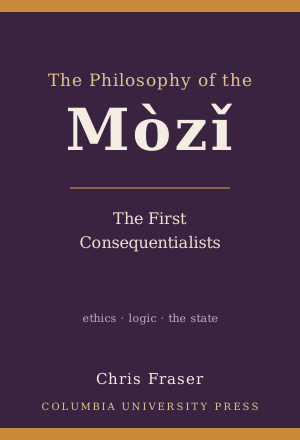
- Title
- The Philosophy of the Mòzǐ: The First Consequentialists
- Author
- Chris Fraser
- Publisher
- Columbia University Press
- Length
- ~408 pp.
- Difficulty
- Advanced ★★★ — a scholarly monograph
Check price & availability on the Amazon product page
What it is — in three lines
This is the leading philosophical monograph on Mohism in English. Rather than a running commentary on the text, Fraser reorganises the whole Mozi by theme — ethics, the good, political authority, motivation, knowledge and language, and the technical logic of the later Mohists — and treats each as a philosophical position to be assessed. He argues that Mohist ethics is a form of consequentialism, judging practices by whether they promote the benefit of all, and that this makes the Mohists the earliest consequentialists on record. It is analysis, not summary — the book that turns Mozi from a historical curiosity into a philosopher you argue with.
The core — Mohism as a system
Fraser's central move is to show that the famous doctrines are not a loose bundle but a structure. Universal or inclusive care is grounded in a conception of the general good; the political theory ("conforming upward," the unification of moral standards) is engineered to secure that good; the epistemology and the theory of names give the Mohists the tools to argue for it and to distinguish right judgement from wrong. Along the way he takes the later Mohists' logic seriously as logic, and he is scrupulous about where the ancient view lines up with modern consequentialism and where it does not. The result is the most philosophically satisfying account of Mozi available — one that respects the texts and still speaks to a contemporary ethicist.
For the Mohists, the fundamental criterion of the moral rightness of conduct, practices, and policies is whether they promote the general welfare.
— on Fraser's reading of the Mohist standard
Three highlights
1. Mohism made a system
Fraser shows how ethics, politics, epistemology, and logic hang together. After this book the doctrines you first met in Watson read as parts of one coherent view.
2. The consequentialist thesis, argued
The claim in the subtitle is not a slogan but a case, weighed against alternatives and qualified where the texts resist it. It is a model of how to read an ancient philosophy as philosophy.
3. The later Mohists taken seriously
Fraser gives real attention to the logic and language of the Mohist Canon, the material most books skip — a natural sequel to reading those chapters in Johnston's complete translation.
What to watch out for
Two honest notes. First, it is a scholarly study, not an introduction: Fraser assumes you already know the basic doctrines, so read Watson's selection (and ideally some of the primary text) first — come to this cold and the argument will outrun you. Second, it is one philosopher's reconstruction: the "first consequentialists" reading is powerful and widely respected but not the only possible one, and Fraser says as much. Taken as the culminating study on this shelf, though, nothing else in English matches it.
Check price & availability on the Amazon product page