Home › Top 5 › Mozi: Basic Writings
Review: Mozi: Basic Writings — the one Mozi to read first
★★★★★4.9 / 5.0 (editorial rating)
Verdict: if you read one Mozi in his own words, read this one. Burton Watson's slim selection carries the doctrines that matter — universal love, the case against offensive war, moderation in expenditure, and the attack on fatalism — in clear, unfussy prose, short enough to finish in an afternoon. The best door into a thinker who is easy to caricature and worth reading whole.
- Title
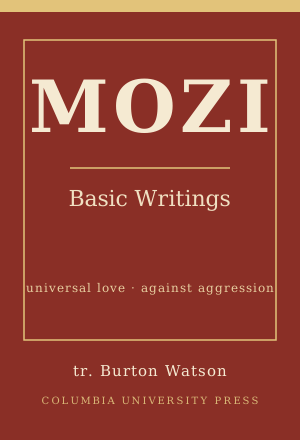
- Mozi: Basic Writings
- Author / Translator
- Mozi (Mo Tzu); translated by Burton Watson
- Publisher
- Columbia University Press (Translations from the Asian Classics)
- Length
- ~140 pp. (selected chapters, with a short introduction)
- Difficulty
- Beginner ★☆☆ — about three hours
Check price & availability on the Amazon product page
What it is — in three lines
This is Burton Watson's selection of the central chapters of the Mozi, the book that gathers the teaching of Mo Di (Mozi) and his followers, the Mohists — the school that challenged Confucianism head-on in the Warring States period. Rather than the full fifty-odd surviving chapters, Watson gives you the doctrinal core, each argument translated in the same plain, confident English that made his versions of Zhuangzi and the Analects standard. It is the shortest honest route to what Mozi actually argued, and the edition most first-time readers should meet him in.
The core — from universal love to against war
Mozi's philosophy runs as a single chain. It begins with universal love (jian ai): the demand that we care for everyone alike, dropping the graded, family-first affection the Confucians defended. From that root grows "against offensive warfare" (fei gong) — if you would not rob one house, how can you justify seizing a whole state? — and then the austere doctrines of moderation in expenditure and in funerals and against music, all attacking the waste that costs the common people their livelihood. Behind them stand the "will of Heaven" and the rejection of fatalism: things are not fixed, so effort is not futile.
Partiality is to be replaced by universality. But how is universality to replace partiality? If men were to regard the states of others as they regard their own, then who would attack the others' state?
— Mozi, "Universal Love"
What makes the selection exhilarating rather than preachy is how consequentialist Mozi already sounds: again and again he tests a practice by asking whether it benefits the people, not whether tradition sanctions it.
Three highlights
1. Watson's plain, trustworthy English
Watson does not decorate. The arguments come through cleanly, so a reader with no Chinese and no background can follow Mozi's reasoning step by step — exactly what you want in a first encounter.
2. The doctrines, not just the label
Because the selection keeps whole chapters, you see how each doctrine is argued, not merely named. "Against offensive warfare" is a worked case, not a slogan — and reading it is the fastest cure for the idea that Mozi was a naive pacifist.
3. Short enough to finish
At around 140 pages this is a book you will actually complete, which means you meet Mozi entire — the ethics, the politics, and the theology together — instead of abandoning a longer volume halfway.
What to watch out for
Two honest notes. First, it is a selection, not the whole Mozi: the technical "Dialectical" chapters (the Mohist Canon) on logic, language, and optics are not here — for those you want Johnston's complete translation. Second, the arguments repay context: read them beside the Mohism chapter of Van Norden's Introduction and you will see why "love everyone equally" was a genuine scandal to Mozi's contemporaries, not the platitude it can sound like today. This book is the core, not the whole tradition.
Check price & availability on the Amazon product page