Home › Top 5 › Introduction to Classical Chinese Philosophy
Review: Introduction to Classical Chinese Philosophy — the map around Mozi
★★★★★4.6 / 5.0 (editorial rating)
Verdict: the secondary book to read beside the selection. Van Norden walks the whole Warring States debate — Confucians, Mohists, Daoists, Legalists — in clear, argument-focused prose, with a chapter devoted to Mohism. Read it and Mozi stops being an isolated list of doctrines and becomes a position under fire: you see who he was arguing with, and why "love everyone equally" was a scandal.
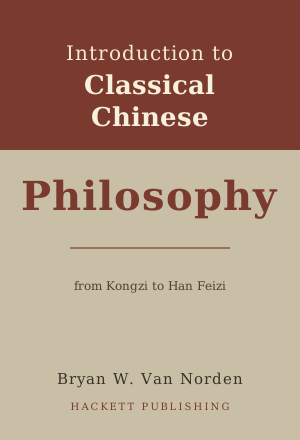
- Title
- Introduction to Classical Chinese Philosophy
- Author
- Bryan W. Van Norden
- Publisher
- Hackett Publishing Company
- Length
- ~304 pp.
- Difficulty
- Beginner ★☆☆ — a readable textbook
Check price & availability on the Amazon product page
What it is — in three lines
This is the leading single-author survey of classical Chinese thought in English, written for readers coming in cold. Van Norden treats the great texts of the Warring States period — the Analects, the Mozi, the Mengzi, the Laozi, the Zhuangzi, the Xunzi, and the Legalists — as live philosophy, reconstructing each thinker's arguments and the objections they faced. Its Mohism chapter is the best short orientation to Mozi you can read in English, and it comes with the surrounding debate built in.
The core — Mohism among its rivals
Mozi's doctrines only make sense as answers. Universal love answers the Confucian defence of graded love (more for your father than for a stranger); "against offensive warfare" answers a world of predatory states; "conforming upward" (shang tong) answers the problem of moral disagreement. Van Norden lays out each of these as a move in an argument, then gives the Confucian and Daoist replies — Mengzi's charge that Mohism "knows no father," the Daoist suspicion of all this earnest doing-good. The effect is to make Mozi's positions sharp rather than quaint. You come away knowing not just what the Mohists believed but what was at stake in believing it.
Because Van Norden is himself a working philosopher, he is unusually good at flagging where a classical argument connects to a modern one — utilitarianism, moral motivation, the objectivity of value — without forcing the texts into Western clothes.
Three highlights
1. A whole map, not a single portrait
You meet Mozi with his opponents in the room. That is exactly the context a first reader of the Mozi is missing, and it converts a list of "-isms" into a debate you can follow.
2. Argument-first exposition
Van Norden reconstructs positions as premises and conclusions, so Mohist reasoning becomes legible to anyone trained in Western philosophy — and legible to anyone not, because he explains as he goes.
3. Apparatus that sends you deeper
Clear chapter bibliographies and study questions make it easy to move from the survey into the primary texts, including the Readings anthology Van Norden co-edited as its companion.
What to watch out for
Two honest notes. First, this is a guide, not the original: it is scaffolding around Mozi, not Mozi himself, and it should be read with the Basic Writings open beside it, not instead of them. Second, it is a survey of the whole period, so the Mohism chapter is one part of a larger book; if you want only Mozi you will be reading around him — though the surrounding chapters are precisely what give his doctrines their edge, so the "detour" is the point.
Check price & availability on the Amazon product page