Home › Top 5 › Readings in Classical Chinese Philosophy
Review: Readings in Classical Chinese Philosophy — Mozi among the schools
★★★★★4.6 / 5.0 (editorial rating)
Verdict: the natural next step once Watson's selection leaves you wanting more. This anthology gives you substantial Mozi selections beside Kongzi (Confucius), Mengzi, Zhuangzi, Xunzi and Han Feizi, each with a clear introduction and notes. You read Mohism not in isolation but as one voice in the argument it was actually part of — the best value primary-text volume for the whole period.
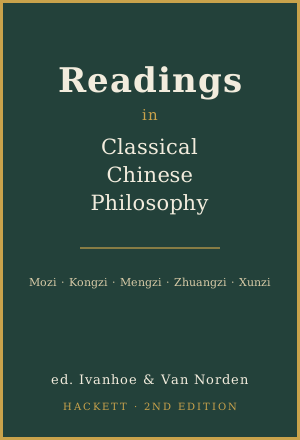
- Title
- Readings in Classical Chinese Philosophy (Second Edition)
- Editors
- Philip J. Ivanhoe & Bryan W. Van Norden
- Publisher
- Hackett Publishing Company
- Length
- ~416 pp.
- Difficulty
- Intermediate ★★☆ — primary texts, well supported
Check price & availability on the Amazon product page
What it is — in three lines
This is the most widely used teaching anthology of early Chinese philosophy in English, the primary-source companion to Van Norden's Introduction. It collects generous selections from the foundational texts — the Analects, the Mozi, the Mengzi, the Laozi, the Zhuangzi, the Xunzi, and the Han Feizi, plus the "White Horse" dialogue — in respected modern translations, each with a concise introduction and notes. For Mozi specifically it gives you more of the primary text than a pocket selection, without the commitment of the 944-page complete work.
The core — Mozi in the conversation
The virtue of an anthology is adjacency. Here Mozi's chapters on universal love and against warfare sit a few pages from Kongzi's defence of ritual and family, and a few more from Mengzi's furious reply that Mohism, in loving all equally, "knows no father." You can read the exchange almost as a dialogue. That is the fastest way to grasp why Mohism was a real intellectual threat — not a gentle humanitarianism but a rigorous, impartial ethics that put Confucian priorities on trial. The Mohist selections are chosen to show the argumentative spine, so you see the doctrines defended, not merely stated.
The translations are by leading scholars and the editorial apparatus is pitched for newcomers: enough to orient you, never so much that it buries the text. It is, in short, a course in the classical debate that you can take on your own.
Three highlights
1. Mozi in context, in the original
You read Mohist arguments beside the rivals answering them. Nothing makes the doctrines land faster than seeing Mengzi and the Confucians push back on the facing pages.
2. One reliable volume for the whole period
If Mozi leads you to the wider Warring States debate — as he should — this single book carries the other schools too, in translations you can trust.
3. A genuine Kindle edition
There is a real Kindle version with a free sample, so you can weigh the translation and the density before buying — unusually convenient for a scholarly anthology.
What to watch out for
Two honest notes. First, it is selections, not the complete Mozi: it gives you more than Watson but still not the technical "Dialectical" chapters — for those you need Johnston's complete translation. Second, because it spans seven texts, the Mozi portion is one section among many; readers who want to live inside the Mozi alone will eventually want a dedicated volume. As a bridge from a short selection to the whole, though, it is close to ideal.
Check price & availability on the Amazon product page