Home › Top 5 › The Mozi: A Complete Translation
Review: The Mozi: A Complete Translation — every chapter, including the Canon
★★★★★4.7 / 5.0 (editorial rating)
Verdict: the whole book, at last. Ian Johnston's translation is the first in a European language to give every surviving chapter of the Mozi — including the notoriously hard "Dialectical" chapters (the Mohist Canon) on logic, language, and even optics that every selection omits. Printed with the Chinese facing the English and thoroughly annotated, it is the reference edition to own once the core doctrines have you hooked.
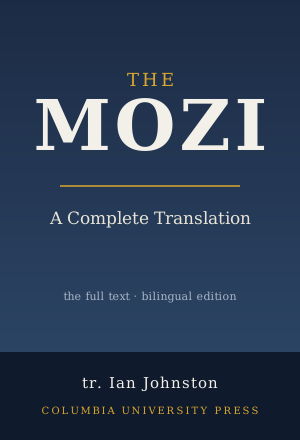
- Title
- The Mozi: A Complete Translation
- Author / Translator
- Mozi (Mo Tzu); translated and annotated by Ian Johnston
- Publisher
- Columbia University Press (Translations from the Asian Classics)
- Length
- ~944 pp. (bilingual, with introduction and notes)
- Difficulty
- Advanced ★★★ — a project, not a sitting
Check price & availability on the Amazon product page
What it is — in three lines
This is the complete Mozi in English: all the surviving chapters of the text, translated and annotated by Ian Johnston, with the classical Chinese printed alongside. Where Watson gives you the doctrinal highlights and the anthology gives you generous selections, Johnston gives you everything — the core "ten doctrines" chapters, the anecdotal and military chapters, and the technical Dialectical chapters that are among the hardest texts in early Chinese thought. It is the scholarly standard for reading the whole work.
The core — what the selections leave out
Most readers meet Mozi through the ethical and political doctrines. But the later Mohists also produced the Mohist Canon — a compressed, almost telegraphic body of writing on definition, logical relations, causation, ethics, geometry, and optics, including some of the earliest systematic reflection on language and inference anywhere. These chapters are corrupt, dense, and easy to skip, and Johnston's achievement is to make them legible: his notes reconstruct the arguments and flag the textual problems so a serious reader can finally follow them. Reading them changes the picture of Mohism from an earnest moral movement into a fully-fledged philosophical school with a theory of knowledge and argument.
The facing-page Chinese is a gift even to readers with only a little classical Chinese, and a standing invitation to check the English against the original.
Three highlights
1. Genuinely complete
Nothing is quietly dropped. For the first time in English you can read the Mozi as a whole book, doctrines and Canon together, and judge the school in full.
2. A translator equal to the Canon
Johnston's annotation of the Dialectical chapters is the part that justifies the volume. He does the reconstructive work that lets a non-specialist follow arguments most translations simply omit.
3. Bilingual and built to last
With the Chinese facing the English and a substantial scholarly apparatus, this is a reference you keep on the shelf and return to, not a book you read once and pass on.
What to watch out for
Two honest notes. First, this is not a starting point: at some 944 pages, much of it demanding, it will overwhelm a first-time reader. Come to it after Watson's selection and Van Norden's introduction have given you the doctrines and the debate. Second, the Dialectical chapters remain hard even here — that is the nature of the text, not a fault of the translation; treat Johnston's notes as your guide and do not expect them to read like the ethical chapters. Owned and used as a reference, it is indispensable; attempted cold, it is a wall.
Check price & availability on the Amazon product page