KUKAI BOOK GUIDE
The 5 Best Kūkai Books (2026)
— Shingon esoteric Buddhism, in reading order
You open a book on Kūkai (Kōbō Daishi) and are pushed straight back by a wall of unfamiliar terms — sokushin jōbutsu, the two mandalas, the ten stages of mind. It is not that Kūkai is beyond you; it is that most readers start in the wrong place. There is a staircase here. Meet Kūkai first in his own luminous prose, then see the living tradition of Shingon he founded, then walk his life with a modern scholar, and only then take on the great theoretical studies. Five English books — all from established academic and Buddhist-studies presses — arranged not by fame but by what you can actually read next.
The editorial room behind this site runs a family of philosopher bookshelves and a section-by-section reading archive of the primary texts (in Japanese) — for example Heidegger's Being and Time. Every recommendation rests on first-hand reading and bibliographic checking, and every page is honest about one fact: the gentle illustrated primers that open the Japanese edition have no English counterpart, so this shelf begins with Kūkai's own words instead.
Our RankingRANKING
The editorial order. If you can't decide, start at #1. Check prices and availability on the Amazon product pages.
-
1
 If in doubt, start hereBeginner
Kūkai: Major Works (Translated, with an Account of His Life and a Study of His Thought)
The single best entry point in English: a hundred-page account of Kūkai's life and thought, followed by eight of his own works in clear translation. You do not read about Kūkai here so much as meet him — the poet-monk who brought esoteric Buddhism from Tang China and founded the Shingon school. One volume, life and words together.
Check price & availability on Amazon / Kindle edition available
View on Amazon Read on Kindle Read our review -
2
 Beginner–Intermediate
Shingon: Japanese Esoteric Buddhism
Once you have met Kūkai, this is the readable map of the tradition he built. Written for Western readers by a Shingon priest and scholar, it lays out the school's history, metaphysics, and — unusually — its actual practices: the mandalas, the three mysteries of body, speech, and mind, mantra and visualization. The most approachable overview of Shingon in English.
Check price & availability on Amazon
View on Amazon Read our review -
3
 Intermediate
Kūkai: Japan's First Vajrayāna Visionary
A recent, single-volume account of how Kūkai forged a distinct identity for the esoteric Buddhism he learned in China — his engagement with debates on the nature of a Buddha's embodiment, and his bold positioning against the other Buddhist schools of his day. The current scholarly biography, and the natural third step once the life and the tradition are in view.
Check price & availability on Amazon
View on Amazon Read our review -
4
 Advanced
Shingon Refractions: Myōe and the Mantra of Light
What happened to Kūkai's esoteric practice after Kūkai? This study follows one thread — the Mantra of Light — through the Kamakura-era monk Myōe Kōben, then gives you six of the primary texts in annotated translation. A focused, scholarly look at Shingon as living, spreading practice rather than founding doctrine.
Check price & availability on Amazon / Kindle edition available
View on Amazon Read on Kindle Read our review -
5
 Advanced
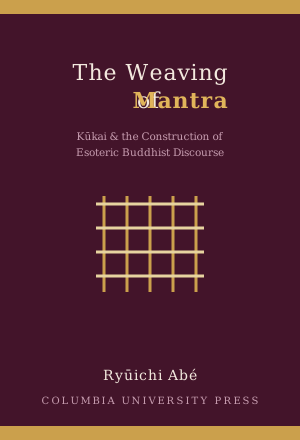
The Weaving of Mantra: Kūkai and the Construction of Esoteric Buddhist Discourse
The summit of this shelf: the major scholarly study of Kūkai in English. Abé argues that Kūkai's real achievement was not founding a sect but constructing a whole theory of language grounded in the ritual speech of mantra. A demanding, brilliant book that rereads early Japanese religious history — the reward for everything below it.
Check price & availability on Amazon
View on Amazon Read our review
The 5 Books at a GlanceCOMPARE
The biggest worry with Kūkai is "can I actually get through the esoteric terminology?" Choose by difficulty and by what each book is really for.
| Title | Difficulty | Length | Type | Best for | Links |
|---|---|---|---|---|---|
| Kūkai: Major Workstr. Yoshito S. Hakeda · Columbia UP | Beginner ★★☆ | ~320 pp. | Primary (life + 8 works) | First contact; you want Kūkai in his own words | View on Amazon Review |
| Shingon: Japanese Esoteric BuddhismTaikō Yamasaki · Shambhala | Beginner–Intermediate ★★☆ | ~256 pp. | Overview + practice | You want the tradition, its metaphysics and its rituals | View on Amazon Review |
| Kūkai: Japan's First Vajrayāna VisionaryDavid L. Gardiner · Hawai‘i | Intermediate ★★☆ | ~340 pp. | Modern biography/study | You want the life and how Kūkai built Shingon's identity | View on Amazon Review |
| Shingon RefractionsMark Unno · Wisdom | Advanced ★★★ | ~200 pp. | Study + translations | You want Shingon practice after Kūkai (the Mantra of Light) | View on Amazon Review |
| The Weaving of MantraRyūichi Abé · Columbia UP | Advanced ★★★ | ~600 pp. | Major scholarly study | You want the deepest reading: Kūkai's theory of language | View on Amazon Review |
A Reading Order That Won't Defeat YouROADMAP
Most readers stall on Kūkai for two reasons: starting with the dense theoretical studies, and trying to memorize terms like the two mandalas and the ten stages of mind as dictionary entries. Instead: his own words → the living tradition → the life and scholarship → the theory. Climb in four steps.
-
STEP 1 ── Meet him in his own words (one book)
Read Kūkai: Major Works — Hakeda's life-account first
Begin with Hakeda's hundred-page account of the life and thought, then dip into the translated works. You will meet the man before the machinery of doctrine, and every term you meet later will have a face and a voice attached to it. This is the map the rest of the shelf fills in.
Major Works on AmazonRead on Kindle -
STEP 2 ── See the living tradition
Yamasaki's Shingon: Japanese Esoteric Buddhism for the whole world of practice
Now widen out. Yamasaki lays the school on the table — its history, its metaphysics, and the rituals that make it esoteric: the mandalas, the three mysteries, mantra and visualization. This is where the vocabulary from Step 1 turns into a working picture of what Shingon actually is and does.
Shingon on Amazon -
STEP 3 ── The life and the scholarship (books 3–4)
Gardiner's biography for the life, Shingon Refractions for the afterlife of the practice
With the map in hand, go deeper. Gardiner reconstructs how Kūkai built Shingon's identity against his rivals; Unno follows the Mantra of Light into later Japanese Buddhism through the monk Myōe. Take them in either order — one looks at the founder, the other at what his practice became.
Gardiner on AmazonShingon Refractions on Amazon -
STEP 4 ── The theory (the goal)
Take on Abé's The Weaving of Mantra
The summit. Abé rereads the whole story to argue that Kūkai's achievement was a theory of language grounded in mantra — not merely a new sect. It is long and demanding, but after Steps 1–3 its difficulty turns from a wall into a climb worth making. Reach the top of the shelf here.
View on AmazonRead our review
How We ChoseCRITERIA
Three criteria. First, currently in print and actually available on amazon.com — every title has a live product page from an established publisher (Columbia University Press, Shambhala, University of Hawai‘i Press, Wisdom Publications). Second, the ladder must hold: his own words → the living tradition → the life and its afterlife → the theory, each step preparing the next, with entry points from a first-person primary source to a six-hundred-page study. Third, honesty about what each book is: a translation is Kūkai speaking, a primer is a map, a scholarly study is an argument — the reviews say which, and where the difficulty spikes. Because Kūkai is a religious founder, we do not promote a sect or an interpretation; we describe the books. The gentle illustrated primers that open our Japanese edition have no English equivalent, so this shelf substitutes the standard English-language scholarship — noted openly on the About page.
Still Undecided? Take This OneCONCLUSION
If you have read this far and still can't choose, the answer is simple: buy Kūkai: Major Works. Very few subjects this esoteric can be entered through a genuine "first book," but Kūkai can — Hakeda's life-account and Kūkai's own writings in one accessible volume, from the founder's own hand. Get your bearings there, and every later book on this shelf will read as a deeper pass over ground you already know. When you want the whole tradition next, go to Yamasaki's Shingon.
Check price & availability on the Amazon product pages