Home › Top 5 › The Weaving of Mantra
Review: The Weaving of Mantra — Kūkai's theory of language
★★★★☆4.4 / 5.0 (editorial rating)
Verdict: the goal of this shelf and the major scholarly study of Kūkai in English. Abé's thesis is bold: Kūkai's importance lies not in founding the Shingon sect but in constructing a general theory of language grounded in the ritual speech of mantra. Long and demanding, it rereads the whole of early Japanese religious history — the reward for everything below it, not the place to begin.
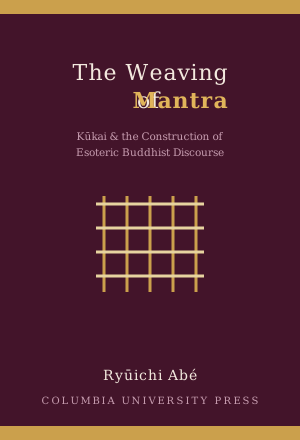
- Title
- The Weaving of Mantra: Kūkai and the Construction of Esoteric Buddhist Discourse
- Author
- Ryūichi Abé
- Publisher
- Columbia University Press
- Length
- Major scholarly study · ~600 pp.
- Difficulty
- Advanced ★★★ — the summit; assumes the rest of the shelf
Check price & availability on the Amazon product page
What it is — in three lines
This is the large, ambitious study that reset scholarship on Kūkai in English. Abé combines historical research, discourse analysis, literary criticism, and semiology to ask what, precisely, Kūkai accomplished when he transmitted esoteric Buddhism to early-ninth-century Japan. His answer is that the true achievement was not the institutional founding of a school but the creation of a general theory of language, built on the ritual speech of mantra — a theory that reshaped how Japanese Buddhism understood scripture, ritual, and reality itself.
The argument that reorders the field
Most accounts frame Kūkai as the founder of Shingon; Abé argues that framing is a later, sectarian back-formation, and that it misses the deeper event. What Kūkai introduced, on this reading, was a way of understanding mantra as language operating at its most fundamental level — not decoration on doctrine but a theory of how words touch reality. The book follows how this "esoteric discourse" was constructed and how it then organized relations among texts, rituals, and institutions across early Heian Buddhism. It is a work of theory as much as history, and its influence is why every other book on this shelf now reads partly in its light. That is exactly why it comes last: its claims land only once you already know the life, the tradition, and the practice it reinterprets.
Three highlights
1. A genuinely new thesis
The move from "founder of a sect" to "author of a theory of language" is the kind of reframing that changes a field. Whether or not you accept it in full, you cannot read Kūkai the same way afterward.
2. Method worth studying in itself
The blend of history with discourse analysis and semiotics makes the book a model of how to read a religious tradition rigorously. Readers from outside Buddhist studies often find the method as instructive as the content.
3. The definitive scale
At roughly six hundred pages it is comprehensive by design. When a question about Kūkai's thought needs the deepest available treatment in English, this is where it is.
What to watch out for
Honestly: this is a hard book, and it is meant to be. The theoretical vocabulary — discourse, semiology, the technical apparatus of textual analysis — is dense, and the length is real. Two defenses. First, come only after the rest of this shelf; the reading order is built to deliver you here prepared, with the life, the tradition, and the practice already in hand. Second, read it as an argument to think with, not a neutral summary: it advances a strong, contested thesis, and part of its pleasure is disagreeing well. If you want the settled outline rather than the cutting-edge case, stay with Hakeda and Gardiner; this is for going all the way in.
Check price & availability on the Amazon product page