Home › Top 5 › Kūkai: Japan's First Vajrayāna Visionary
Review: Kūkai: Japan's First Vajrayāna Visionary — the current biography
★★★★☆4.3 / 5.0 (editorial rating)
Verdict: the up-to-date scholarly life. Where Hakeda's fifty-year-old study still serves as the first biography, Gardiner (2024) is the one that carries the current conversation — how Kūkai forged a distinct identity for the esoteric Buddhism he learned in China, and how he argued his new school into a crowded religious landscape. The right third step: the life, seen through modern scholarship.
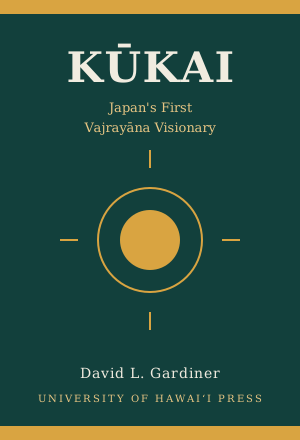
- Title
- Kūkai: Japan's First Vajrayāna Visionary
- Author
- David L. Gardiner
- Publisher
- University of Hawai‘i Press (2024)
- Length
- Modern biography/study · ~340 pp.
- Difficulty
- Intermediate ★★☆ — scholarly, but built around the life
Check price & availability on the Amazon product page
What it is — in three lines
Published in 2024 by the University of Hawai‘i Press, this is a wide-ranging study of how the ninth-century founder of Japanese Shingon forged a unique identity for the meditative and ritual practices he brought back from two years in Tang China. It follows Kūkai's engagement with live debates — reaching back to India and China — about the levels of embodiment attributed to a Buddha, and traces his rhetorical positioning against the other Buddhist schools of early Heian Japan. The author is a scholar of religion who has worked on Kūkai and Vajrayāna Buddhism for many years.
What it adds to the older biography
Hakeda's life-study is still the gentlest way in, but it is decades old. Gardiner brings the modern picture: less a chronicle of events than an argument about how Kūkai made esoteric Buddhism Japanese — how he distinguished it from the established schools, what he claimed for it, and why. The book takes seriously the intellectual debates behind Kūkai's confidence, so you come away understanding not just what he did but the stakes he thought he was fighting for. Read after Yamasaki's overview, it gives the tradition a founder with motives, rivals, and a case to make.
Three highlights
1. Current scholarship, in one volume
For a reader who wants the present state of the field on Kūkai's life and self-presentation, this is the single most convenient place to find it.
2. Kūkai as a strategist of ideas
The focus on how he positioned Shingon against other schools makes his boldness legible — the confidence that could declare a new path superior is shown resting on real argument, not mere assertion.
3. A bridge to the theoretical studies
By foregrounding the debates Kūkai entered, the book prepares you for the deeper claims about language and mantra that Abé develops at the summit of this shelf.
What to watch out for
Two honest notes. First, it is a scholarly monograph, not a popular biography: it assumes you already have Kūkai's outline in mind, which is exactly why it sits at Step 3 rather than Step 1 — come to it after Major Works and Yamasaki. Second, as a recent hardback from a university press it is priced accordingly; check the Amazon page for the current format and price. If you want the life told simply first, start with Hakeda and return here for the modern reading.
Check price & availability on the Amazon product page