Home › Top 5 › Shingon: Japanese Esoteric Buddhism
Review: Shingon: Japanese Esoteric Buddhism — the tradition Kūkai built
★★★★☆4.4 / 5.0 (editorial rating)
Verdict: the readable map of the whole school. Written for Western readers by a priest and scholar of the tradition, it covers Shingon's history, its metaphysics, and — rare in English — its actual practices: the two mandalas, the three mysteries, mantra and visualization. After Kūkai in his own words, this is where the vocabulary becomes a working picture.
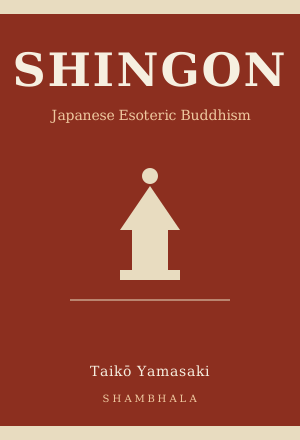
- Title
- Shingon: Japanese Esoteric Buddhism
- Author
- Taikō Yamasaki (with translators and editors)
- Publisher
- Shambhala
- Length
- Overview + practice · ~256 pp. (with illustrations, notes, index)
- Difficulty
- Beginner–Intermediate ★★☆ — the most accessible overview of the school
Check price & availability on the Amazon product page
What it is — in three lines
This is the first comprehensive account of Shingon to appear in a Western language, drawn from the teaching of Taikō Yamasaki, a Shingon priest and university scholar. It moves from the tradition's history and its founder through its metaphysics — the cosmic buddha Mahāvairocana, the two mandalas of the Womb and Diamond realms — and on to the practices that make it esoteric: the three mysteries of body, speech, and mind, mudra, mantra, and visualization. It is written to be understood by readers with no prior training.
Why it belongs at Step 2
Kūkai's own writings tell you what he taught; this book shows you how the tradition works. That is a different and complementary thing. Where a primary source can leave a newcomer holding terms with no context, Yamasaki assembles them into a system you can see: the mandalas are not just named but explained as maps of reality and of practice; the three mysteries are shown as the way a practitioner's body, speech, and mind are brought into alignment with the buddha's. Because the author is inside the tradition, the practices are described from the inside — with the caution proper to esoteric material — rather than catalogued from outside. Read after Major Works, it turns Kūkai's vocabulary into a coherent world.
Three highlights
1. The most approachable overview in English
Many later studies are dense academic prose; this one was written to teach. It remains the book most often handed to a curious beginner who wants the whole of Shingon, not a fragment.
2. Practice, not just doctrine
Few English books on Japanese Buddhism give real space to what practitioners actually do. Yamasaki devotes chapters to it, which is exactly what makes the abstract metaphysics finally click into place.
3. Written from within the tradition
The author's standing as a Shingon priest gives the descriptions an authority a purely external survey cannot match — while the editorial framing keeps it usable by outsiders.
What to watch out for
Two things. First, because it is written from within Shingon, it presents the tradition largely on its own terms; it is an authoritative overview, not a critical or comparative history, and we recommend it as the former. For the outside scholarly angle — how Kūkai constructed the school's identity, and how esoteric discourse was built — go on to Gardiner and Abé. Second, some passages on advanced practice are necessarily reserved, as esoteric transmission is by nature guarded; treat the book as an orientation to the world of Shingon, not a practice manual. Neither point changes its value as the clearest single door into the tradition.
Check price & availability on the Amazon product page