Home › Top 5 › Shingon Refractions
Review: Shingon Refractions — Myōe and the Mantra of Light
★★★★☆4.2 / 5.0 (editorial rating)
Verdict: the book that shows Kūkai's practice after Kūkai. Unno follows a single thread — the Mantra of Light — through the Kamakura-era monk Myōe Kōben, then hands you six of the source texts in annotated translation. A focused, scholarly demonstration that Shingon was not a museum piece but a living practice that refracted across later Japanese Buddhism.
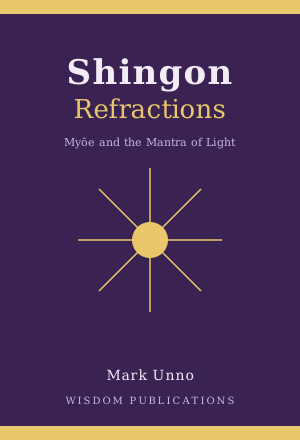
- Title
- Shingon Refractions: Myōe and the Mantra of Light
- Author
- Mark Unno
- Publisher
- Wisdom Publications
- Length
- Study + translations · ~200 pp. (two parts)
- Difficulty
- Advanced ★★★ — scholarly, with primary texts
Check price & availability on the Amazon product page
What it is — in three lines
The book is built in two halves. The first is an intellectual and cultural history of the Mantra of Light — one of the central practices to grow out of the esoteric tradition Kūkai founded — and of Myōe Kōben, the Kamakura-era monk who became its foremost champion. The second half gives six texts on the Mantra of Light in careful, annotated translation. Together they show a Shingon practice moving beyond the boundaries of the school, into the wider Buddhism of medieval Japan.
Why "refractions"
Every book before this one on the shelf looks at Kūkai and his school directly. Unno turns the light sideways. His subject is what happened when the esoteric current Kūkai released passed through other figures and other schools — refracting, like light through a prism, into forms Kūkai never designed. Myōe, working four centuries later and not a Shingon sectarian in a narrow sense, becomes the case study: the Mantra of Light in his hands is a practice open to ordinary devotees, evidence that Kūkai's legacy was a living resource and not a sealed doctrine. This is the "modern re-reading" slot of the shelf — a scholar taking one bright thread and following it far downstream.
Three highlights
1. History and primary texts in one book
You get the argument and then the evidence: read the cultural history, then the very texts it rests on, translated and annotated. It is an unusually complete package for a focused study.
2. Shingon as spreading practice
By centering the Mantra of Light and Myōe, the book corrects any impression that esoteric Buddhism stayed locked inside one lineage. It shows the tradition doing what living traditions do.
3. A doorway to Kamakura Buddhism
Reading Kūkai's afterlife through a Kamakura monk quietly opens the larger story of medieval Japanese Buddhism — a natural place for the shelf to point outward.
What to watch out for
Be clear about scope. This is not a book about Kūkai's own life or doctrine; its hero is Myōe and its subject is one later practice. Come to it only after you have Kūkai himself in view — which is why it sits at Step 3–4, not earlier. The translated texts in Part 2 are scholarly and reward slow reading; if the history in Part 1 is what draws you, it stands on its own. For the founder's own theory of mantra rather than its later use, go on to Abé.
Check price & availability on the Amazon product page