KIERKEGAARD BOOK GUIDE
The 5 Best Kierkegaard Books (2026)
— from an introduction to Fear and Trembling, in reading order
"Anxiety is the dizziness of freedom." "The self is a relation that relates itself to itself." The lines are unforgettable — and then you open the book they come from and the ground drops away. Kierkegaard writes under a crowd of pseudonyms, argues by indirection, and doubles back on himself on purpose. Most people who bounce off him do so because they dive into a primary text alone, first. The cure is order: get a map of the life and the ideas, meet him first through his most dramatic short book, and only then take on the harder works. These five titles are arranged not by fame or chronology but by readability and by the order in which they make sense.
The editorial room behind this site runs a family of philosopher bookshelves and a section-by-section reading archive of the primary texts (in Japanese). This English edition selects five books currently in print on amazon.com, all from established houses (Oxford, Penguin, Picador), chosen on the same principle as our sister Socrates and Nietzsche shelves: never let you pick the wrong first book.
Our RankingRANKING
The editorial order. If you can't decide, start at #1. Check prices and availability on the Amazon product pages.
-
1
 If in doubt, start hereIntermediate
Fear and Trembling
His most famous book, and the best door into his actual writing. Taking the moment Abraham raises the knife over his son, Kierkegaard asks what faith really demands — and finds it more frightening than any ethics. Short, gripping, and single-minded, it gives you the real Kierkegaard without the sprawl of the longer works.
Check price & availability on Amazon
View on Amazon Read our review -
2
 Beginner
Kierkegaard: A Very Short Introduction
The scholar's short map. Gardiner sets Kierkegaard against the ethical and religious theories of Kant and Hegel he was fighting, and lays out the core ideas — the stages of life, anxiety, the single individual, the leap of faith — in a hundred and thirty careful pages. The map to keep open beside every primary text below.
Check price & availability on Amazon / Kindle edition available
View on Amazon Read on Kindle Read our review -
3
 Intermediate
Philosopher of the Heart: The Restless Life of Søren Kierkegaard
A prize-winning modern biography that reads like a novel. Carlisle, a philosopher at King's College London, tells the story from inside Kierkegaard's own restless experience — the broken engagement to Regine, the war with the newspapers and the Church — because with this thinker the life and the ideas are inseparable. Read it and the concepts stop being abstract.
Check price & availability on Amazon / Kindle edition available
View on Amazon Read on Kindle Read our review -
4
 Advanced
The Sickness unto Death
"The sickness unto death is despair." Writing as Anti-Climacus, Kierkegaard dissects despair as a failure to be a self — and builds one of the most rigorous analyses of the human condition ever written. It is the depth-charge of his authorship; take it on once the map and the life are in place, and Hannay's introduction has warmed you up.
Check price & availability on Amazon / Kindle edition available
View on Amazon Read on Kindle Read our review -
5
 Advanced
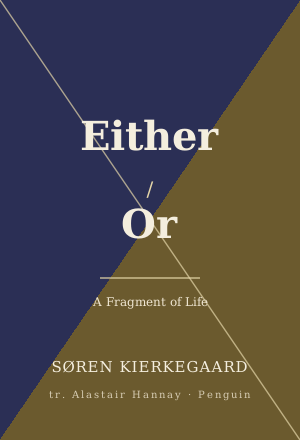
Either/Or: A Fragment of Life
The great early work that made his name: two ways of living set side by side — the aesthetic life of the pleasure-seeker "A" and the ethical life of Judge Wilhelm — and left, deliberately, for you to choose between. Hannay's single-volume Penguin abridgement makes this sprawling masterpiece portable. The advanced finish, for when the shorter works have you hooked.
Check price & availability on Amazon / Kindle edition available
View on Amazon Read on Kindle Read our review
The 5 Books at a GlanceCOMPARE
The biggest worry with Kierkegaard is "can I actually read this?" The two guides (an introduction and a biography) are the safe entry; the three primary works climb in difficulty. Choose by difficulty and length.
| Title | Difficulty | Length | Type | Best for | Links |
|---|---|---|---|---|---|
| Fear and Tremblingtr. Hannay · Penguin Classics | Intermediate ★★☆ | ~160 pp. ~4 hrs |
Primary (his most famous) | First real Kierkegaard; you want the dramatic, single-minded book | View on Amazon Review |
| Kierkegaard: A Very Short IntroductionPatrick Gardiner · OUP | Beginner ★☆☆ | ~136 pp. ~4 hrs |
Scholarly introduction | You want the ideas and the context mapped before the texts | View on Amazon Review |
| Philosopher of the HeartClare Carlisle · Picador | Intermediate ★★☆ | ~368 pp. ~9 hrs |
Modern biography | You want the life as a story, because it explains the ideas | View on Amazon Review |
| The Sickness unto Deathtr. Hannay · Penguin Classics | Advanced ★★★ | ~208 pp. 1–2 weeks |
Primary (with introduction) | You want the rigorous anatomy of despair and the self | View on Amazon Review |
| Either/Or: A Fragment of Lifetr. Hannay, abridged · Penguin | Advanced ★★★ | ~640 pp. 2–3 weeks |
Primary (abridged) | You are hooked and want the great early masterpiece | View on Amazon Review |
A Reading Order That Won't Defeat YouROADMAP
People bounce off Kierkegaard for two reasons: diving into a pseudonymous primary text with no sense of the life behind it, and trying to memorise "despair," "anxiety" and "the single individual" as dictionary terms. So: get the map, meet the man, read the most famous work, then go deep. Four steps.
-
STEP 1 ── Get the map (one book)
Read the Very Short Introduction for the ideas and the fight behind them
Before any primary text, spend an afternoon with Gardiner. He lays out the stages of life, anxiety, the single individual and the leap of faith, and — crucially — shows what Kierkegaard was arguing against in Kant and Hegel. Keep it open as a reference beside everything below.
Very Short Introduction on AmazonRead on Kindle -
STEP 2 ── Meet the man (read in parallel)
Let Philosopher of the Heart turn the concepts into a life
Kierkegaard's ideas grow directly out of his experience — the broken engagement, the pseudonymous authorship, the final war with the Church. Carlisle's biography reads like a novel and makes "the single individual" and "despair" land as one man's hard-won words rather than jargon. You can read it alongside the introduction.
Philosopher of the Heart on AmazonRead on Kindle -
STEP 3 ── Read the most famous work (the main event)
Take on Fear and Trembling — the real Kierkegaard, in one short book
With the map and the life in place, read his most celebrated text. Abraham's silent journey to Mount Moriah is short, dramatic and self-contained, which makes it the ideal first primary work: you close it having actually read Kierkegaard, not a summary of him. This is where the shelf earns its keep.
Fear and Trembling on AmazonRead our review -
STEP 4 ── Go deep (the goal)
Finish with The Sickness unto Death, then Either/Or
Now the harder works pay off. The Sickness unto Death gives you the rigorous anatomy of despair and the self; Either/Or, in Hannay's portable abridgement, sets the aesthetic and ethical lives side by side and hands you the choice. Take them in that order — the shorter, tighter book first — and you have climbed the whole shelf.
The Sickness unto Death on AmazonEither/Or on Amazon
How We ChoseCRITERIA
Three criteria. First, currently in print and actually available on amazon.com — every title has a live product page from an established publisher (Oxford University Press, Penguin Classics, Picador / Farrar, Straus and Giroux). Second, the ladder must hold: a short introduction and a readable biography first, then his most famous primary work, then the two harder books — each step preparing the next. Third, honesty about what each book is: Kierkegaard wrote many of his works under pseudonyms who hold views he does not simply endorse, so a primary text is an argument staged, not a doctrine handed down, and the reviews say so. This English edition differs from our Japanese edition, which compares two translations of a single work; because English has an abundance of established Kierkegaard translations, we present five distinct works instead. The editorial room runs a family of philosopher bookshelves and a section-by-section archive of the primary texts (in Japanese); those first-hand readings are the foundation here.
Still Undecided? Take This OneCONCLUSION
If you have read this far and still can't choose, the answer is simple: buy Fear and Trembling. It is his most famous book, it is short, and it gives you the real, unsettling Kierkegaard in a single afternoon's reading rather than a summary of him. If even that feels daunting, spend an hour first with Gardiner's Very Short Introduction to get the lay of the land, and come back.
Check price & availability on the Amazon product pages