Home › Top 5 › Philosopher of the Heart
Review: Philosopher of the Heart — the life that explains the ideas
★★★★★4.7 / 5.0 (editorial rating)
Verdict: the most enjoyable book on this shelf, and the one that does the most quiet work. Clare Carlisle, a philosopher at King's College London, writes Kierkegaard's biography from the inside — as far as possible from his own point of view — so that the broken engagement, the pseudonyms and the last war with the Church become the soil the ideas grow from. Read it and "despair" and "the single individual" stop being terms and become one man's experience.
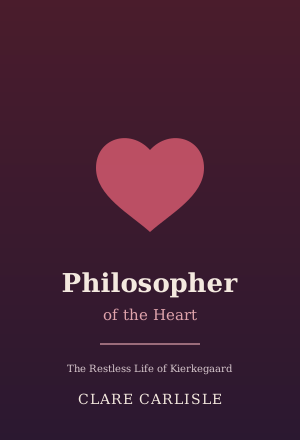
- Title
- Philosopher of the Heart: The Restless Life of Søren Kierkegaard
- Author
- Clare Carlisle
- Publisher
- Picador / Farrar, Straus and Giroux (2019)
- Length
- Biography · ~368 pp.
- Difficulty
- Intermediate ★★☆ — reads easily, thinks deeply
Check price & availability on the Amazon product page
What it is — in three lines
Published in 2019 to wide acclaim, Philosopher of the Heart is a biography of Søren Kierkegaard by Clare Carlisle, Professor of Philosophy at King's College London. Rather than march from birth to death, it opens in the middle of his life — a train journey back to Copenhagen — and moves outward, telling the story with the texture of a novel while keeping the philosophy always in view. It won praise as one of the finest recent books on Kierkegaard for general readers.
Why the life matters here
With most philosophers you can separate the doctrines from the biography. With Kierkegaard you cannot. His broken engagement to Regine Olsen, his decision to write under a crowd of pseudonyms, his ferocious final attack on the Danish Church — these are not background to the ideas; they are the ideas, lived. Carlisle's achievement is to show the connection without ever reducing the thought to mere autobiography.
Life can only be understood backwards, but it must be lived forwards.
— Kierkegaard, journal entry (widely quoted; a touchstone of Carlisle's book)
Because she is a philosopher, the concepts are handled accurately; because she is a fine writer, they arrive as story. That is exactly what a reader between the introduction and the primary texts needs — the map made human.
Three highlights
1. Regine
The engagement Kierkegaard broke off — and never got over — shadows almost everything he wrote. Carlisle handles it with unusual tact and shows how the private wound feeds the public work, including Fear and Trembling.
2. The pseudonyms as a strategy
Why publish Either/Or as "Victor Eremita" editing papers by two strangers? Carlisle makes Kierkegaard's "indirect communication" comprehensible — a deliberate method for making readers think for themselves rather than swallow conclusions.
3. The last battle
The final year, when Kierkegaard spent his health and his fortune attacking the comfortable Christianity of the state Church, is told with real drama — and it reframes the whole authorship as the work of a man determined to make faith cost something again.
What to watch out for
Two honest notes. First, this is a biography, not a systematic exposition: it will give you the shape and stakes of the ideas superbly, but for the concepts set out in order you still want Gardiner's Very Short Introduction beside it — the two are complementary, not substitutes. Second, Carlisle's structure is artful rather than strictly chronological, which is a pleasure once you relax into it but can briefly disorient a reader who wants dates in a row. Neither is a real drawback; both are worth knowing going in.
Check price & availability on the Amazon product page