Home › Top 5 › Fear and Trembling
Review: Fear and Trembling — faith on Mount Moriah
★★★★★4.6 / 5.0 (editorial rating)
Verdict: the book to start with. Kierkegaard's most famous work, short enough to read in an afternoon, and gripping enough to pull you through. Behind the pseudonym Johannes de Silentio, it stares at the moment Abraham raises the knife over his own son and asks what faith could possibly mean if it demands that. You finish it having read the real Kierkegaard — not a summary — and with the questions the rest of this shelf answers.
- Title
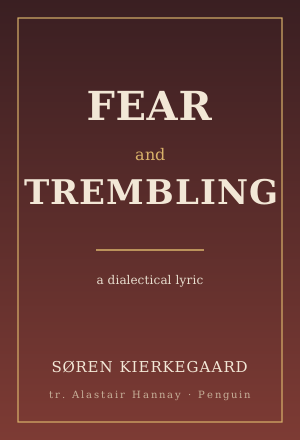
- Fear and Trembling
- Author
- Søren Kierkegaard (as Johannes de Silentio), tr. Alastair Hannay
- Publisher
- Penguin Classics (original: 1843)
- Length
- Primary source · ~160 pp. (text + introduction and notes)
- Difficulty
- Intermediate ★★☆ — short, but it argues by indirection
Check price & availability on the Amazon product page
What it is — in three lines
Published in 1843 under the pseudonym Johannes de Silentio ("John of the Silence"), Fear and Trembling circles a single scene from Genesis: God commands Abraham to sacrifice his son Isaac, and Abraham sets out to obey. From that one act Kierkegaard builds a meditation on what separates faith from ethics, from resignation, and from madness. It is his best-known book and, at roughly a hundred pages of text, his most concentrated.
Why it can be your first primary text
Most of Kierkegaard's works are long, many-voiced and easy to get lost in. This one is not. It fixes on a single image and refuses to let go, which means a first-time reader always knows what is being discussed even when the argument turns difficult. The famous idea at its centre — the "teleological suspension of the ethical," the thought that faith might require going beyond right and wrong as the community understands them — is genuinely unsettling, but it is anchored to a story you already know.
Faith is precisely this paradox, that the single individual is higher than the universal.
— Kierkegaard, Fear and Trembling (widely quoted formulation)
You can read it in an afternoon like a strange, tense story, and close it holding a question about whether faith is the highest thing a person can reach or the most terrifying. For a primary philosophical text, that combination of brevity and force is rare.
Three highlights
1. The four re-tellings of Abraham
The book opens with a section that imagines the journey to Mount Moriah four different ways, each a slightly different Abraham. It is a small masterclass in how Kierkegaard thinks — not by stating a thesis but by turning a case in the light until you feel the problem from the inside.
2. "The knight of faith"
Against the tragic hero and the "knight of infinite resignation," Kierkegaard sets the knight of faith, who gives everything up and yet believes he will receive it back "on the strength of the absurd." It is one of the most haunting figures in modern philosophy, and it is here in its original form.
3. Silence and the impossibility of explaining
Abraham cannot justify himself to anyone — not to Sarah, not to Isaac — because faith at this pitch cannot be translated into the shared language of ethics. The pseudonym's own name, "de Silentio," is the point. It lands hard on a reader who has ever held a conviction they could not argue for.
What to watch out for
Two honest notes. First — and this governs the whole site — this is a pseudonymous work. Johannes de Silentio explicitly says he is not himself a man of faith; he is a character Kierkegaard uses to press the question, not a mouthpiece for a settled doctrine. Do not read the book as Kierkegaard's tidy "theory of faith"; read it as a staged provocation. Second, the short length is deceptive. The opening "Exordium" and "Panegyric" are readable, but the three "Problema" sections argue by indirection and reward slow reading — this is why we place it after Gardiner's Very Short Introduction and Carlisle's biography, not before them.
Check price & availability on the Amazon product page