Home › Top 5 › The Sickness unto Death
Review: The Sickness unto Death — the anatomy of despair
★★★★☆4.5 / 5.0 (editorial rating)
Verdict: the depth-charge of the authorship. Under the pseudonym Anti-Climacus, Kierkegaard defines despair not as a mood but as a failure to be the self you are meant to be — and then dissects it with a rigour that reads, at moments, like a work of formal logic. It is the hardest of the primary works on this shelf and the most rewarding; take it on once the map and the life are in place.
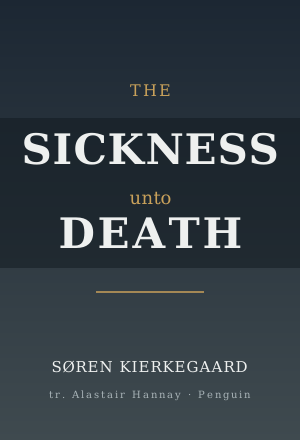
- Title
- The Sickness unto Death
- Author
- Søren Kierkegaard (as Anti-Climacus), tr. Alastair Hannay
- Publisher
- Penguin Classics (original: 1849)
- Length
- Primary source · ~208 pp. (text + introduction and notes)
- Difficulty
- Advanced ★★★ — the opening pages are famously dense
Check price & availability on the Amazon product page
What it is — in three lines
Published in 1849 under the pseudonym Anti-Climacus, and subtitled A Christian Psychological Exposition for Edification and Awakening, this is Kierkegaard's most sustained analysis of despair. The "sickness unto death" is not a physical illness but the spiritual condition of a self at odds with itself — and, ultimately, cut off from the power that grounds it. In roughly a hundred and fifty pages of text it moves from an abstract account of the self to a taxonomy of every form despair can take.
The core — despair as a relation gone wrong
The book is notorious for its opening definition, one of the most quoted and most parodied sentences in philosophy:
The self is a relation that relates itself to itself… in relating itself to itself, and in willing to be itself, the self is grounded transparently in the power that established it.
— Kierkegaard (Anti-Climacus), The Sickness unto Death, opening pages
Push through it and the payoff is enormous. From this single formula Kierkegaard generates a complete map of despair: the despair of not wanting to be oneself, the despair of defiantly wanting to be oneself, and — most unsettling — the despair one does not even know one is in. His claim is that this last, unconscious despair is the ordinary condition of most people most of the time. Few books have described the modern self with such cold precision.
Three highlights
1. The taxonomy of despair
Kierkegaard sorts despair with an almost clinical patience — by whether you are conscious of it, by whether you flee the self or cling to it. Reading it is like being handed a diagnostic chart for states you had felt but never named.
2. "The crowd is untruth"
The analysis is inseparable from his lifelong theme of the single individual: despair is something you can only be cured of one by one, never as part of a mass. It is the philosophical engine behind everything he wrote against the comfortable Christianity of his age.
3. The turn to faith
The opposite of despair, in this book, is not happiness but faith — the self resting transparently in the power that established it. Whether or not you share the theology, the structure of the argument is a landmark, and it echoes straight into twentieth-century thought.
What to watch out for
Two honest notes. First, the first fifteen pages are the hardest in this whole shelf. The abstract definition of the self is deliberately compressed, and many readers stall there. The remedy is simple: do not try to master it on first contact — read on, let the concrete kinds of despair illuminate the formula in retrospect, and circle back. Hannay's introduction helps a great deal. Second — the governing note of this site — this is a pseudonymous work: Anti-Climacus represents a level of Christian ideality Kierkegaard pointedly did not claim for himself, so read the book as a demanding standard held up, not as the author's casual opinion.
Check price & availability on the Amazon product page