Review: Either/Or — the choice between two lives
★★★★☆4.3 / 5.0 (editorial rating)
Verdict: the great early masterpiece, and the goal of this shelf. Two ways of living are laid out at full length — the aesthetic life of the pleasure-seeker "A" and the ethical life of Judge Wilhelm — and Kierkegaard, hiding behind a fictional editor, refuses to tell you which to choose. Hannay's single-volume abridgement makes an eight-hundred-page work portable without gutting it. Read it last, when the shorter books have you hooked.
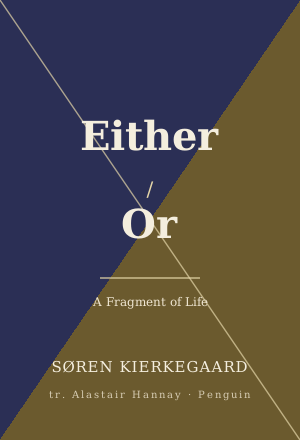
- Title
- Either/Or: A Fragment of Life
- Author
- Søren Kierkegaard (as Victor Eremita, ed.), tr. Alastair Hannay — abridged
- Publisher
- Penguin Classics (original: 1843)
- Length
- Primary source · ~640 pp. (single-volume abridgement)
- Difficulty
- Advanced ★★★ — long, and deliberately many-voiced
Check price & availability on the Amazon product page
What it is — in three lines
Kierkegaard's first major book, published in 1843, presents itself as a bundle of papers discovered by one "Victor Eremita" and printed without comment. The first volume gives the writings of an unnamed young aesthete, "A" — including the famous "Diary of a Seducer"; the second is a pair of long, earnest letters from "B," Judge Wilhelm, arguing for the ethical life. The book stages two whole ways of being and leaves the reader standing at the fork.
The core — two lives, no verdict
The title is the argument. Either the aesthetic life — lived for the interesting, the beautiful, the immediate — or the ethical life of commitment, marriage, work and continuity. "A" makes the case for the first with dazzling wit and an undertow of despair; the Judge answers with the slower, deeper appeal of choosing oneself and taking responsibility for a life over time.
Marry, and you will regret it. Do not marry, and you will also regret it… This, gentlemen, is the sum of all practical wisdom.
— Kierkegaard (as "A"), Either/Or, "Diapsalmata"
Crucially, Kierkegaard does not adjudicate. By publishing under a fictional editor who declines to decide, he forces the choice back onto you — the purest example of his "indirect communication." The book does not tell you how to live; it makes the question unavoidable.
Three highlights
1. The "Diapsalmata"
The aphorisms that open the book are among the most brilliant and bleak things Kierkegaard ever wrote — the aesthetic sensibility distilled, glittering and hollow at once. Even readers who go no further remember them.
2. Judge Wilhelm's answer
The second volume is easy to underrate because it is less flashy, but its defence of the ethical life — of choosing to become a self rather than merely sampling experiences — is the moral heart of the book and the seed of everything later.
3. The form itself
That the two lives never meet, never debate directly, and are handed to us by an editor who shrugs, is the whole point. Either/Or is as much a demonstration of a method as a statement of a view — Kierkegaard teaching you to think for yourself by refusing to do it for you.
What to watch out for
Two honest notes. First, length and structure. Even abridged this is the longest book on the shelf, and it is deliberately uneven — brilliant aphorisms, a novella, a treatise on Mozart, then two vast letters. Read it in sections rather than at a run, and do not expect a single argument marching to a conclusion. Second — the governing note of this site — the voices are pseudonymous characters, not Kierkegaard. "A" and Judge Wilhelm are positions he constructs and sets against each other; neither is simply his own view. That is why we place it last, once Gardiner's Introduction and Carlisle's biography have taught you how his indirection works.
Check price & availability on the Amazon product page