Home › Top 5 › A Very Short Introduction
Review: Kierkegaard: A Very Short Introduction — the map to keep open
★★★★☆4.4 / 5.0 (editorial rating)
Verdict: the safest possible first step. In about a hundred and thirty pages, the late Oxford philosopher Patrick Gardiner sets out who Kierkegaard was, what he was arguing against, and what his central ideas actually claim. It is not a book to fall in love with — it is a reference to keep open on the desk while you read the primary works. Bought first, it saves you from misreading everything that follows.
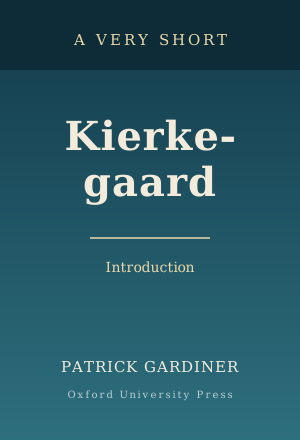
- Title
- Kierkegaard: A Very Short Introduction
- Author
- Patrick Gardiner
- Publisher
- Oxford University Press (Very Short Introductions)
- Length
- Introduction · ~136 pp.
- Difficulty
- Beginner ★☆☆ — dense but genuinely introductory
Check price & availability on the Amazon product page
What it is — in three lines
Part of Oxford's Very Short Introductions series, this is a compact scholarly overview of Kierkegaard's life and thought by Patrick Gardiner, a philosopher at Magdalen College, Oxford. It places him in his nineteenth-century setting — above all in opposition to Hegel's system and to the Danish state Church — and walks through the ideas most readers come for: the stages on life's way, anxiety and despair, the single individual, and faith.
Why it belongs first
Kierkegaard is hard not because his sentences are obscure but because his books assume you already know the argument he is fighting. Read Fear and Trembling cold and you may not see that it is a reply to a whole tradition — Kant's ethics, Hegel's confidence that the individual is fulfilled in the universal — which it exists to overturn. Gardiner supplies exactly that missing context, calmly and in order.
His aim was not to construct a system but to make his reader aware of what it is to exist as a single, responsible individual.
— editorial paraphrase of Gardiner's framing
Because it is a map rather than a destination, you do not need to finish it before starting the primary works. Read it once, then keep it beside you and turn back to the relevant chapter whenever a text below loses you.
Three highlights
1. Kierkegaard versus Hegel, made clear
The single most useful thing an introduction can do here is explain the quarrel with Hegel — and Gardiner does it plainly, so that the primary works stop looking like free-floating aphorisms and start looking like the pointed replies they are.
2. The stages of life, laid out in order
Aesthetic, ethical, religious: the "stages" or "spheres of existence" are Kierkegaard's organising scheme, and Gardiner sets them out so you can see how Either/Or and Fear and Trembling each dramatise a different one.
3. Restraint
Gardiner does not sell you an interpretation. He reports the debates, marks what is contested, and leaves the judgement to you — precisely the neutrality you want in a first book, before you have views of your own to defend.
What to watch out for
One honest note: "very short" does not mean "easy." Gardiner writes for an intelligent general reader but at real intellectual density, and the chapters on Hegel and on the theory of stages ask for attention. This is a strength, not a flaw — a thin, breezy summary would leave you unprepared for the primary works — but do not expect a picture-book. If you would like the life told as a narrative alongside it, read Carlisle's Philosopher of the Heart in parallel; the two complement each other perfectly.
Check price & availability on the Amazon product page