DAVID HUME BOOK GUIDE
The 5 Best David Hume Books (2026)
— from a short introduction to the Treatise, in reading order
"Reason is, and ought only to be the slave of the passions." The philosopher who argued that cause and effect is nothing but habit, and who woke Kant from his "dogmatic slumber," is one of the most readable of the greats — and one of the easiest to start in the wrong place. Reach first for the youthful Treatise of Human Nature, and its 700 pages can turn you straight back. Hume has a staircase you can actually climb. A short introduction, then the Enquiry he wrote to be read, then the Treatise, then a philosopher's reading of it. Five books, in an order that works.
The editorial room behind this site runs a family of philosopher bookshelves — for example The Philosophy Bookshelf and Socrates — and a section-by-section reading archive of the primary texts (in Japanese). Every recommendation rests on first-hand reading, and every page here is honest about one fact: Hume said most of it twice, and the second, shorter time is the better door in.
Our RankingRANKING
The editorial order. If you can't decide, start at #1. Check prices and availability on the Amazon product pages.
-
1
 If in doubt, start hereBeginner
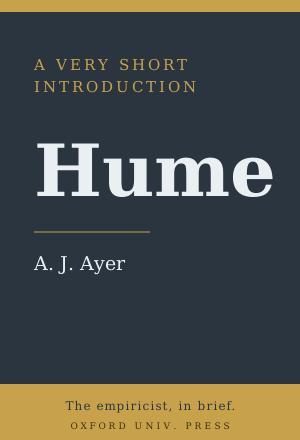
Hume: A Very Short Introduction
The best entry point: a short, brisk map of Hume's whole naturalist project — perception, the self, causation, morality, religion — written by A. J. Ayer, himself one of the twentieth century's great empiricists. It carries a short life of Hume too, so you meet the man and the ideas at once.
Check price & availability on Amazon
View on Amazon Read our review -
2
 IntermediateBest primary text to start
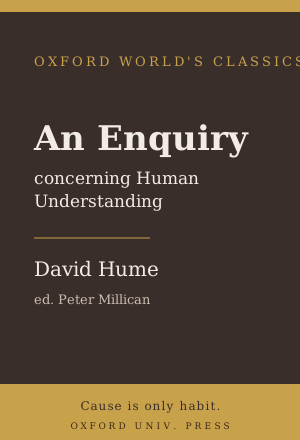
An Enquiry concerning Human Understanding
If you read only one Hume in his own words, read this. It is Hume's own shorter recasting of the Treatise's epistemology — induction, causation, the "problem of induction," and the famous essay on miracles — in Millican's authoritative Oxford text with a first-rate introduction and notes. Readable, and genuinely the heart of Hume.
Check price & availability on Amazon / Kindle edition available
View on Amazon Read on Kindle Read our review -
3
 Advanced
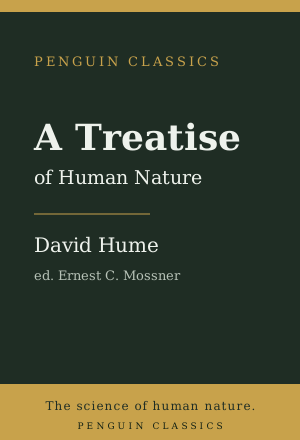
A Treatise of Human Nature
The youthful masterwork Hume wrote in his twenties — the fullest statement of his philosophy across the understanding, the passions, and morals. It "fell dead-born from the press" in its day and is now a classic. Long and demanding, but once the Enquiry has given you the core, this is where the whole system opens out.
Check price & availability on Amazon / Kindle edition available
View on Amazon Read on Kindle Read our review -
4
 Advanced
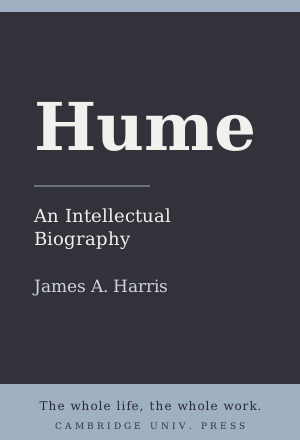
Hume: An Intellectual Biography
The standard modern life: Harris follows Hume's whole career — from the Treatise to the essays, the Enquiries, and the best-selling History of England — and treats him as he wished to be treated, as a man of letters, not only the author of one famous argument. The book to reach for when the ideas make you curious about the man and his century.
Check price & availability on Amazon / Kindle edition available
View on Amazon Read on Kindle Read our review -
5
 Advanced
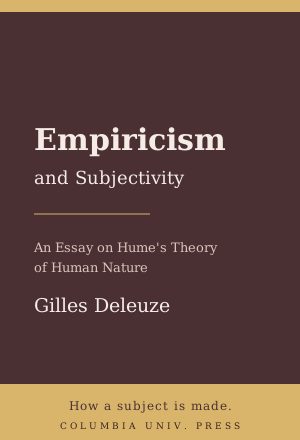
Empiricism and Subjectivity: An Essay on Hume's Theory of Human Nature
Deleuze's first book (1953), a reading of Hume that turns the usual picture inside out: empiricism is not "where do ideas come from?" but "how does a mind become a subject?" — through the principles of association and the passions. Difficult, but a bracing finish that shows a classic still generating new thought.
Check price & availability on Amazon
View on Amazon Read our review
The 5 Books at a GlanceCOMPARE
The biggest worry with Hume is "will the sceptical arguments lose me?" Choose by difficulty and by type — introduction, primary text, biography, study.
| Title | Difficulty | Length | Type | Best for | Links |
|---|---|---|---|---|---|
| Hume: A Very Short IntroductionA. J. Ayer · OUP | Beginner ★☆☆ | ~144 pp. ~3 hrs |
Introduction | First contact; the whole map in one sitting | View on Amazon Review |
| An Enquiry concerning Human Understandinged. Millican · Oxford World's Classics | Intermediate ★★☆ | ~304 pp. ~8 hrs |
Primary (accessible) | Reading one Hume in his own words | View on Amazon Review |
| A Treatise of Human Natureed. Mossner · Penguin Classics | Advanced ★★★ | ~720 pp. 3–5 weeks |
Primary (magnum opus) | The whole system, in full | View on Amazon Review |
| Hume: An Intellectual BiographyJames A. Harris · Cambridge | Advanced ★★★ | ~640 pp. a project |
Biography | The man, the works, the century | View on Amazon Review |
| Empiricism and SubjectivityDeleuze, tr. Boundas · Columbia | Advanced ★★★ | ~176 pp. 1–2 weeks |
Study (a philosopher's reading) | Seeing Hume through Deleuze | View on Amazon Review |
A Reading Order That Won't Defeat YouROADMAP
People bounce off Hume for two reasons: starting with the 700-page Treatise, and trying to memorise "cause," "custom," and "the association of ideas" before meeting the arguments that give them life. Introduction → the accessible primary work → the magnum opus → a philosopher's reading. Climb in four steps.
-
STEP 1 ── Get the map (one book)
Read Ayer's Very Short Introduction
Don't dive into a primary text yet. Ayer lays out the whole of Hume — causation, the self, morality, religion — in a few hours, and one great empiricist's read of another is a rare pleasure. The point is to dissolve the caricature of Hume as "just a sceptic" before you open him.
Ayer's Introduction on Amazon -
STEP 2 ── Read one Hume, in his words (the core)
The Enquiry concerning Human Understanding
Now the primary text — but the right one. Hume rewrote his epistemology into this shorter, cleaner book and asked to be judged by it. Induction, causation as habit, and the essay on miracles, in the readable Oxford edition. Finish this and you have read the heart of Hume in the original.
The Enquiry on AmazonRead on Kindle -
STEP 3 ── The whole system (the magnum opus)
Take on the Treatise — and meet the man in Harris
With the core in hand, the Treatise stops being a wall and becomes a landscape: the understanding, the passions, and morals as one "science of human nature." Read it with Harris's Intellectual Biography beside you if you want the life and the century that produced it.
The Treatise on AmazonHarris's Biography on Amazon -
STEP 4 ── A philosopher's reading (the goal)
Deleuze's Empiricism and Subjectivity
Finish with a reading that makes Hume strange again. The young Deleuze asks not where ideas come from but how a mind becomes a subject, and turns empiricism into a live problem. Reach it after the originals and you are watching a classic generate new philosophy — which is where this shelf was always heading.
Deleuze on AmazonRead our review
How We ChoseCRITERIA
Three criteria. First, currently in print and actually available on amazon.com — every title has a live product page from an established publisher (Oxford, Penguin, Cambridge, Columbia University Press). Second, the ladder must hold: introduction → accessible primary text → magnum opus → a philosopher's reading, each step preparing the next, with an entry point at every height from a three-hour primer to a 700-page classic. Third, honesty about what each book is: the Enquiry is Hume's own shorter recasting of the Treatise and the better door in; the biography is scholarship, not a light life; Deleuze's study is a creative reading, not an impartial summary. The reviews say so. The editorial room runs a family of philosopher bookshelves and a section-by-section archive of the primary texts (in Japanese); those first-hand readings are the foundation here.
Still Undecided? Take This OneCONCLUSION
If you have read this far and still can't choose: start with Ayer's Very Short Introduction, then read the Enquiry. The introduction gives you the whole map of Hume — cause, custom, the self, morality, religion — in an afternoon, and the Enquiry is the one primary text to read if you read only one. That two-book route is this shelf's recommendation; everything else builds from there.
Check price & availability on the Amazon product pages