Home › Top 5 › An Intellectual Biography
Review: Hume: An Intellectual Biography — the whole life, the whole work
★★★★☆4.4 / 5.0 (editorial rating)
Verdict: the modern life to own. Harris follows Hume across his entire career — not just the philosophy but the essays, the political writing, and the History of England that actually made him famous — and insists on reading him as the man of letters he wished to be. Substantial scholarship, and the book to reach for once the ideas make you curious about the man.
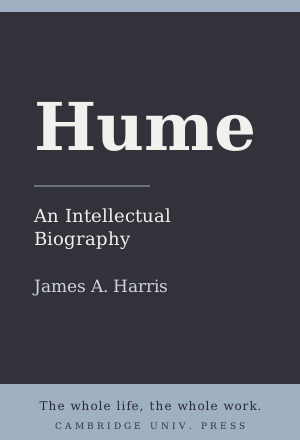
- Title
- Hume: An Intellectual Biography
- Author
- James A. Harris (University of St Andrews)
- Publisher
- Cambridge University Press (paperback reissue)
- Length
- ~640 pp.
- Difficulty
- Advanced ★★★ — a reference to live with, not read in a sitting
Check price & availability on the Amazon product page
What it is — in three lines
James A. Harris's intellectual biography of David Hume — the first full-scale life to take in the whole of Hume's writing, not only the philosophy. It reads the Treatise, the essays, the two Enquiries, the Natural History of Religion, and the six-volume History of England as the connected work of a single career. A major piece of scholarship, and now the standard modern life.
The core — Hume as a man of letters
Harris's organising claim is simple and corrective: Hume did not think of himself as "a philosopher" in our narrow, academic sense. He wanted to be a man of letters, and after the Treatise underperformed he deliberately turned to the essay, to history, to whatever form would reach an educated public. Read that way, the career stops looking like "one great book and a long decline" and becomes a coherent lifelong project — which is exactly how it looked to Hume.
My love of literary fame, my ruling passion, never soured my temper, notwithstanding my frequent disappointments.
— Hume, My Own Life; the self-portrait Harris takes seriously
The payoff for a reader of the philosophy is context: you see why Hume recast the Treatise into the Enquiries, and why the sceptic was also the century's most popular historian.
Three highlights
1. The whole bibliography, connected
Almost every guide stops at Book I of the Treatise. Harris keeps going — essays, politics, religion, history — and shows the threads between them. It is the best single account of what Hume actually spent his life writing.
2. History without hagiography
Harris is careful about evidence and undramatic about the man; this is intellectual biography, tracking the development of a mind, not a novelistic "life." The restraint is a virtue when the subject is a philosopher famous for it.
3. A reference that repays dipping
You do not have to read it straight through. Read the chapter on the work you are currently reading — the Treatise, or the first Enquiry — and Harris earns his place beside the primary text.
What to watch out for
Two honest notes. First, this is not the introduction. At ~640 scholarly pages it assumes you already care about Hume; for the quick map, that is Ayer's job. Second, it is an intellectual biography, weighted to the writing and its development — if you want gossip, romance, and the texture of Enlightenment Edinburgh, temper expectations. Its greatness is precisely that it stays on the work. Use it as a companion to the Treatise and the Enquiry, not as a substitute for them.
Check price & availability on the Amazon product page