Home › Top 5 › A Treatise of Human Nature
Review: A Treatise of Human Nature — the magnum opus, and how to read it
★★★★★4.5 / 5.0 (editorial rating)
Verdict: the whole of Hume, in the book he wrote in his twenties. Across the understanding, the passions, and morals, he attempts one continuous "science of human nature" — the most ambitious single work in British philosophy. It is long and it is hard, and it is best opened after the Enquiry. Come to it in order and the wall becomes a landscape.
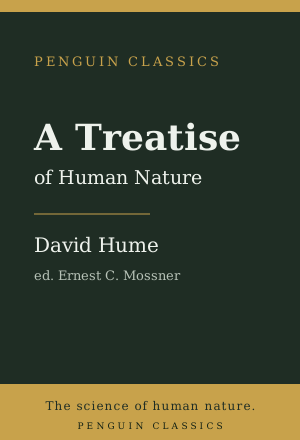
- Title
- A Treatise of Human Nature
- Author / Editor
- David Hume; edited and introduced by Ernest C. Mossner
- Publisher
- Penguin Classics
- Length
- ~720 pp.
- Difficulty
- Advanced ★★★ — a three-to-five-week project
Check price & availability on the Amazon product page
What it is — in three lines
Hume's first and largest work (1739–40), written before he was thirty. In three books — "Of the Understanding," "Of the Passions," "Of Morals" — he tries to do for the mind what Newton did for nature: build a unified, empirical science of human nature. This single-volume Penguin Classics reading text, edited by Ernest C. Mossner, is the standard affordable edition of the complete work.
The core — one science of human nature
The Treatise's ambition is what the Enquiry leaves out. Book I gives the famous epistemology — impressions and ideas, causation, the self that Hume cannot find when he looks for it. But Books II and III are where the system completes itself: the passions as the real springs of action, and morality as grounded in sentiment rather than reason. It is here that the "is/ought" remark appears, almost in passing, and here that Hume's picture of a human being — feeling first, reasoning in service of feeling — is fully drawn.
'Tis not contrary to reason to prefer the destruction of the whole world to the scratching of my finger.
— Hume, Treatise II.iii.3, on the limits of reason over the passions
Reading the whole is the only way to see that Hume's scepticism about reason is the setup for a positive, and startlingly modern, theory of the mind.
Three highlights
1. The parts the Enquiry never covers
The theory of the passions (Book II) and the sentimentalist ethics (Book III) exist in full only here. If Book I hooked you in the Enquiry, this is where you finally get the rest of Hume.
2. A young philosopher swinging for everything
The Treatise has the electricity of a first book by a genius who has not yet learned caution. It overreaches, doubles back, and dazzles — the appendix where Hume confesses he cannot make his own account of the self work is one of the most honest moments in philosophy.
3. One volume, complete
Mossner's Penguin edition puts the entire work in a single, portable, inexpensive book with a helpful introduction — the practical way to own and read the whole thing.
What to watch out for
Two honest notes, and they are the reason this book sits at #3 and not #1. First, do not start here. The Treatise "fell dead-born from the press" in 1740, and plenty of modern readers have re-enacted the failure by opening it cold. Read Ayer then the Enquiry first; you will read the Treatise in a third of the time and twice the pleasure. Second, this is a reading text: for close scholarly work, the Oxford (Norton & Norton) critical edition with full apparatus is the reference — but for actually reading the book cover to cover, Penguin is the right tool.
Check price & availability on the Amazon product page