Home › Top 5 › An Enquiry concerning Human Understanding
Review: An Enquiry concerning Human Understanding — the one Hume to read first
★★★★★4.7 / 5.0 (editorial rating)
Verdict: if you read one Hume in his own words, read this one. Hume himself rewrote the Treatise's epistemology into this shorter, sharper book and asked to be judged by it. Induction, causation as habit, the limits of reason, and the essay on miracles — the heart of Hume, in Millican's authoritative Oxford edition. The best door into the originals.
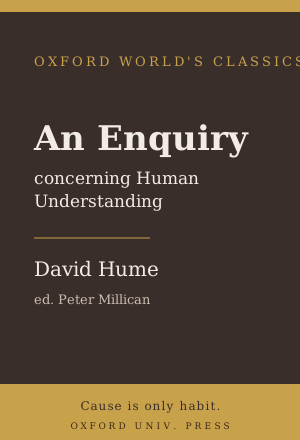
- Title
- An Enquiry concerning Human Understanding
- Author / Editor
- David Hume; edited with an introduction by Peter Millican
- Publisher
- Oxford University Press (Oxford World's Classics)
- Length
- ~304 pp. (text with introduction and notes)
- Difficulty
- Intermediate ★★☆ — about eight hours
Check price & availability on the Amazon product page
What it is — in three lines
Hume's 1748 Enquiry is his own shorter, cleaner rewriting of the epistemology of the youthful Treatise — the book he wanted read as the mature statement of his philosophy. This Oxford World's Classics edition, edited by Peter Millican, gives you the authoritative text with a substantial introduction and notes that quietly do half the hard work for a first-time reader. Accessible, complete, and the standard student edition.
The core — cause, custom, and the limits of reason
The spine of the book is the analysis of causation. We never observe a necessary connection between cause and effect, Hume argues — only that one kind of event has always been followed by another. Our confidence that it will go on doing so is not proof but custom: a habit of the mind, not a dictate of reason. From this grows the "problem of induction," and, in the famous Section X, the argument that testimony can never make a miracle the more credible explanation.
Custom, then, is the great guide of human life.
— Hume, Enquiry, Section V
What makes it exhilarating rather than merely negative is Hume's tone: he is not tearing knowledge down but showing what it actually rests on, and finding that enough to live by.
Three highlights
1. Hume's own preferred version
This is not a digest by someone else — it is Hume streamlining Hume, cutting the Treatise's longueurs and sharpening the arguments he most cared about. You are reading the philosopher at his most deliberate.
2. Millican's apparatus
The introduction and notes are among the best in any student edition of Hume: they set up the problem of induction and the miracles argument clearly, flag the scholarly debates, and never bury the text. For a first reading, the editor is doing exactly the right amount.
3. The miracles essay, in context
Section X ("Of Miracles") is the most notorious thing Hume wrote, and reading it inside the whole argument about evidence and probability — rather than as a stand-alone provocation — is worth the price of admission.
What to watch out for
Two honest notes. First, it is still a philosophy classic, not a beach read: the prose is eighteenth-century and the arguments repay slow reading. If you have not yet, spend three hours with Ayer's introduction first — the Enquiry goes twice as fast with the map in hand. Second, this is the epistemology only; Hume's moral philosophy lives in its companion, the Enquiry concerning the Principles of Morals, and the full system — the passions especially — is in the Treatise. This book is the core, not the whole.
Check price & availability on the Amazon product page