Home › Top 5 › A Very Short Introduction
Review: Hume: A Very Short Introduction — one great empiricist on another
★★★★☆4.3 / 5.0 (editorial rating)
Verdict: the single best first move. In an afternoon Ayer draws the whole of Hume — causation, the self, morality, religion — and does it with the authority of a philosopher who spent his own life defending empiricism. Read this, and every primary text afterwards has somewhere to sit.
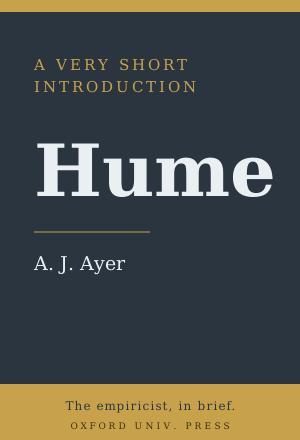
- Title
- Hume: A Very Short Introduction
- Author
- A. J. Ayer (philosopher; author of Language, Truth and Logic)
- Publisher
- Oxford University Press (Very Short Introductions)
- Length
- ~144 pp.
- Difficulty
- Beginner ★☆☆ — about three hours
Check price & availability on the Amazon product page
What it is — in three lines
A short introduction to David Hume by A. J. Ayer, in Oxford's Very Short Introductions series. Not a retelling of Hume's life but a working survey of his philosophy: the theory of knowledge and causation, the self, the passions, the foundations of morals, and the critique of religion — with a brief account of the life to hold it together. Short, but written by a major philosopher who thought Hume was largely right.
The core — Hume without the caricature
Hume is remembered in slogans: cause and effect is "only" habit; you cannot derive an "ought" from an "is"; miracles are never credible. Taken alone, they make him sound like a man who only ever said no. Ayer's real service is to show the constructive naturalism underneath — Hume is building a "science of human nature," an account of how minds like ours actually form beliefs, feel, and judge, once you stop expecting reason to deliver more than it can.
Reason is, and ought only to be the slave of the passions.
— Hume, Treatise II.iii.3; Ayer uses lines like this to show the positive theory behind the scepticism (editorial gloss)
That is the value of the book: the slogans you arrived with get connected to a system, and you leave holding the theory instead of the catchphrase.
Three highlights
1. Empiricist on empiricist
Ayer is not a neutral guide; he is Hume's twentieth-century heir, and he reads him with a practitioner's eye for which arguments still bite. That partisanship is a feature — you see which parts of Hume a serious empiricist still wants to defend, and where even an ally thinks he overreached.
2. The whole map, fast
Knowledge, causation, the self, the passions, morals, religion — the entire territory in one short book, so that when you open the Enquiry or the Treatise you already know which country you are in.
3. Brevity with a point of view
The series format forbids padding, and Ayer turns economy into argument: every chapter takes a stand on what Hume achieved. It is a primer that a specialist can still argue with.
What to watch out for
Two honest notes. First, it is Ayer's Hume. His logical-empiricist sympathies shape the emphases — light on Hume the historian and essayist, keen on the theory of meaning — so treat the readings as strong interpretations, not neutral reportage. For the man and the full career, pair it with Harris's Intellectual Biography. Second, it is a map, not the territory: it is preparation for reading Hume, not a substitute. The point of Step 1 is to get you to Step 2 — the Enquiry — in good order.
Check price & availability on the Amazon product page