Home › Top 5 › Empiricism and Subjectivity
Review: Empiricism and Subjectivity — Hume, turned inside out
★★★★☆4.0 / 5.0 (editorial rating)
Verdict: the finish that makes Hume strange again. Deleuze's first book asks not "where do our ideas come from?" but "how does a collection of impressions become a subject?" — and rebuilds empiricism around that question. Difficult and unmistakably Deleuze, not a neutral commentary. Reach it after the originals and you watch a classic generate new philosophy.
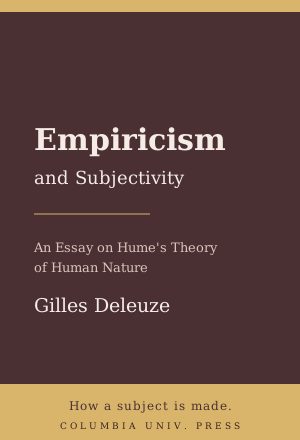
- Title
- Empiricism and Subjectivity: An Essay on Hume's Theory of Human Nature
- Author / Translator
- Gilles Deleuze; translated with an introduction by Constantin V. Boundas
- Publisher
- Columbia University Press (European Perspectives)
- Length
- ~176 pp.
- Difficulty
- Advanced ★★★ — one to two weeks, read slowly
Check price & availability on the Amazon product page
What it is — in three lines
Gilles Deleuze's first book, published in French in 1953 when he was in his twenties, here in Constantin Boundas's English translation (with a substantial translator's introduction). It is a short, dense reading of Hume — subtitled An Essay on Hume's Theory of Human Nature — that treats the Treatise not as a museum piece but as the starting point for a philosophy of how subjectivity is constituted.
The core — how a subject is made
Standard readings of Hume ask an epistemological question: what can we know, given that all we have are impressions and ideas? Deleuze flips it into a question about the self. The mind, for Hume, begins as a mere collection of perceptions — a "bundle." So how does it become a subject, something that believes, expects, and cares? Deleuze's answer: through the principles of association and the passions, which organise the given into a self that transcends what is merely given to it. Empiricism becomes a theory of subject-formation.
The mind is not a subject; it is a collection... The subject is constituted inside the given by the principles of human nature.
— the book's guiding move, paraphrased (editorial gloss)
Whether or not it is "the real Hume," it is a genuinely illuminating way to read him — and the seed of everything Deleuze did later.
Three highlights
1. The origin of a major philosopher
This is where Deleuze begins. Read it and you see the questions — the given, difference, subject-formation — that he will carry through his whole career. For anyone heading toward Deleuze, it is the natural first step, and Hume is the doorway.
2. A creative reading, openly
Deleuze does not pretend to summarise; he thinks with Hume toward his own ends. That is the interest of it — you watch a classic being used, not embalmed — and Boundas's introduction is candid about where Deleuze departs from the scholarly consensus.
3. Short, and repays rereading
Under 180 pages, but not quick: the density rewards a second pass, ideally with the Treatise open beside it. A concentrated finish rather than a long one.
What to watch out for
Two honest notes. First, this is the last book on the list for a reason. It presupposes Hume — read Ayer, the Enquiry, and ideally the Treatise first, or Deleuze's moves will feel arbitrary. Second, it is Deleuze's Hume: brilliant, partial, and not a substitute for a scholarly account. If you want "what Hume scholars think Hume meant," that is Harris and the primary texts; this is what one great philosopher made of another. Read as that, it is superb.
Check price & availability on the Amazon product page