FOUCAULT BOOK GUIDE
The 5 Best Michel Foucault Books (2026)
— from Discipline and Punish, in reading order
You picked up The Order of Things, read the dizzying first page about a Chinese encyclopaedia, and quietly put it down again. It happens to almost everyone. Foucault is genuinely hard — but the usual reason people give up is starting with the wrong book. There is a staircase you can climb. Begin with a short map of his thought, get the feel of "reading Foucault" from his most gripping major work, Discipline and Punish, and only then take on the early archaeologies. This shelf orders five English editions not by chronology but by how readable they are and the order in which they make sense.
The editorial room behind this site runs a family of philosopher bookshelves and a section-by-section reading archive of the primary texts — sister English shelves include the Philosophy Bookshelf and the Nietzsche Bookshelf. Every recommendation rests on first-hand reading, and every page is honest about which book is a scholar's introduction, which is Foucault in his own words, and which is a major work with real bone in it.
Our RankingRANKING
The editorial order. If you can't decide, start at #1. Check prices and availability on the Amazon product pages.
-
1
 If in doubt, start hereIntermediate (flagship)
Discipline and Punish: The Birth of the Prison
Why did modern society give up torture and public execution, and turn instead to surveillance and "discipline"? From the scaffold to the timetable, from the army to the school to the prison, Foucault traces the quiet machinery of the watching eye — crystallised in Bentham's Panopticon. His biggest-selling book, the origin of every later argument about the surveillance society, and, if you read only one Foucault, this is it.
Check price & availability on Amazon / Kindle edition available
View on Amazon Read on Kindle Read our review -
2
 Beginner
Foucault: A Very Short Introduction
The best short map before you set out. Gutting, a leading Anglophone scholar of Foucault, refuses the one-formula summary and instead walks through the recurring problems — madness, knowledge, power, the self — with wit and clarity. A hundred and forty pocket pages that make the major works legible instead of intimidating. Read this and you will never again lose the thread of what Foucault is actually doing.
Check price & availability on Amazon / Kindle edition available
View on Amazon Read on Kindle Read our review -
3
 Intermediate
The Foucault Reader
Foucault in his own words, curated. Rabinow assembles key extracts, essays and interviews — including "What Is Enlightenment?" and the famous discussion of the Panopticon — into a single volume that spans the whole career. Better to meet Foucault's own prose in short, chosen pieces than to be defeated by a whole treatise. The anthology to read alongside the introduction, so you never mistake a summary for the thing itself.
Check price & availability on Amazon / Kindle edition available
View on Amazon Read on Kindle Read our review -
4
 Advanced
The History of Sexuality, Vol. 1: An Introduction
The book that overturned the story we tell about sex. We imagine the Victorians as repressive and ourselves as liberated — but Foucault argues the modern age did not silence sex, it made us talk about it endlessly, and in that talk produced a new kind of power over life itself ("biopower"). Short but concentrated, it is the gateway to the late Foucault and one of the most cited works in the humanities.
Check price & availability on Amazon / Kindle edition available
View on Amazon Read on Kindle Read our review -
5
 Advanced — the summit
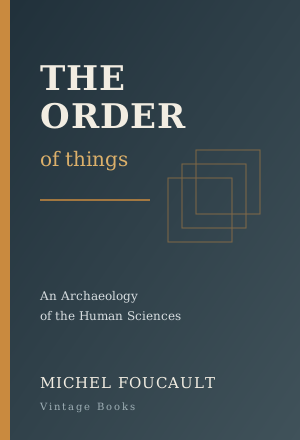
The Order of Things: An Archaeology of the Human Sciences
"Man is an invention of recent date. And one perhaps nearing its end." The book that made Foucault famous in France excavates the buried codes — the epistemes — that decided what could count as knowledge in each age, and ends by announcing that "man" himself is a recent and possibly temporary figure. The hardest climb on this shelf, and the one that shows the full reach of his ambition.
Check price & availability on Amazon / Kindle edition available
View on Amazon Read on Kindle Read our review
The 5 Books at a GlanceCOMPARE
The biggest worry with Foucault is "can I actually read this?" Choose by difficulty and by type — introduction, anthology, or major work.
| Title | Difficulty | Length | Type | Best for | Links |
|---|---|---|---|---|---|
| Discipline and Punishtr. Sheridan · Vintage | Intermediate ★★☆ | ~333 pp. | Major work (flagship) | If you read only one Foucault | View on Amazon Review |
| Foucault: A Very Short IntroductionGary Gutting · OUP | Beginner ★☆☆ | 144 pp. | Scholarly introduction | You want the map before the prose | View on Amazon Review |
| The Foucault Readered. Rabinow · Pantheon | Intermediate ★★☆ | ~400 pp. | Anthology (his own words) | You want Foucault himself, in short pieces | View on Amazon Review |
| The History of Sexuality, Vol. 1tr. Hurley · Vintage | Advanced ★★★ | ~168 pp. | Major work | You want the argument on power and life | View on Amazon Review |
| The Order of ThingsVintage Books | Advanced ★★★ | ~416 pp. | Major work (early) | You want the full reach of his ambition | View on Amazon Review |
A Reading Order That Won't Defeat YouROADMAP
People give up on Foucault for two reasons: starting with an early archaeology like The Order of Things, and trying to memorise the vocabulary (power, discourse, episteme) as if from a dictionary. Map first, flagship next, hard works last. Climb in four steps.
-
STEP 1 ── Get the map (one short book)
Read Gutting's Very Short Introduction first
Before diving into a single major work, spend a couple of hours with the overview. Gutting lays out the problems Foucault kept returning to and how the books hang together, so that everything you read afterwards has a place to go. A hundred and forty pages; it fits in a pocket and dissolves the "this is impossible" feeling.
Very Short Introduction on Amazon -
STEP 2 ── Hear his own voice (in parallel)
Dip into The Foucault Reader for the primary texts
An introduction tells you about Foucault; the Reader lets you read him. Rabinow's chosen extracts and interviews are short enough to finish and important enough to matter, so you get the texture of the actual prose without committing to a whole book. Read it alongside Step 1 — a page or two at a time — so a summary never stands in for the real thing.
The Foucault Reader on Amazon -
STEP 3 ── Read the flagship (the breakthrough)
Take on Discipline and Punish and feel yourself "reading Foucault"
Of the major works this is the most gripping and the easiest to follow: a real historical drama from the scaffold to the timetable, driven by the unforgettable image of the Panopticon. Finish one major work and the rest of Foucault suddenly feels within reach. This is the success experience the whole shelf is built around.
Discipline and Punish on Amazon -
STEP 4 ── The harder works (the goal)
The History of Sexuality → The Order of Things, for the reach and the origins
Now the ambitious works pay off. The short, sharp History of Sexuality, Vol. 1 takes you into the late Foucault and "biopower"; the early Order of Things shows where the whole project began, digging beneath knowledge itself. Both are demanding — but after Steps 1–3, the difficulty turns from a wall into a climb worth making. Reach here and this shelf has done its job.
History of Sexuality on AmazonThe Order of Things on Amazon
How We ChoseCRITERIA
Three criteria. First, currently in print and actually available on amazon.com — every title has a live product page from an established publisher (Vintage, Oxford University Press, Pantheon), in the standard English translations by Alan Sheridan and Robert Hurley. Second, the ladder must hold: a short scholarly map, then Foucault in his own words, then the most readable major work, then the harder archaeology and the late turn — each step preparing the next. Third, honesty about what each book is: an introduction is a map, not the territory; an anthology gives you chosen extracts, not whole arguments; and a major work asks for real time. The reviews say exactly which is which. The Japanese edition of this shelf builds the same ladder around the standard Shinchōsha translations and Gen Nakayama's introductions; because those two introductions have no English counterpart, this edition substitutes Gutting's Very Short Introduction and the Rabinow Reader in the same roles, and swaps in The History of Sexuality as the fourth title. The editorial room runs a family of philosopher bookshelves and a section-by-section archive of the primary texts; those first-hand readings are the foundation here.
Still Undecided? Take This OneCONCLUSION
If you have read this far and still can't choose, the answer is simple: buy Discipline and Punish. Of Foucault's major works it is the most gripping and the easiest to follow, and it deals with power, discipline and surveillance — themes that speak directly to the present. Read it and you will always have "the Foucault of the Panopticon" as your anchor for everything else. If a major work still feels daunting, spend an hour with Gutting's Very Short Introduction first — that is the route this shelf recommends.
Check price & availability on the Amazon product pages