Home › Top 5 › The Order of Things
Review: The Order of Things — the archaeology of knowledge and the end of "man"
★★★★☆4.3 / 5.0 (editorial rating)
Verdict: the summit of this shelf. The book that made Foucault famous in France digs beneath the ordinary history of ideas to the buried codes that decide what can even count as knowledge in a given age — and ends by announcing that "man," the supposed centre of the modern sciences, is a recent invention that may be nearing its end. The hardest and most exhilarating climb here; attempt it only once the rest of the shelf is behind you.
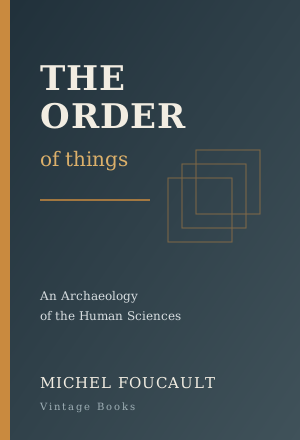
- Title
- The Order of Things: An Archaeology of the Human Sciences
- Author
- Michel Foucault
- Publisher
- Vintage Books (reissue paperback)
- Length
- Major work (early) · ~416 pp.
- Difficulty
- Advanced ★★★ — the summit; give it real time
Check price & availability on the Amazon product page
What it is — in three lines
An early, ambitious work of what Foucault then called "archaeology." It asks a strange and powerful question: not what people believed in a given period, but what made certain beliefs thinkable at all — the deep grammar underneath biology, economics and the study of language. Ranging across three centuries, it argues that knowledge is organised by hidden systems that shift abruptly, and closes with the striking claim that "man" as an object of science is a very recent arrival.
The core — the episteme
Foucault's key term here is the episteme: the underlying code of a period that fixes what counts as an object of knowledge, what counts as a valid statement, and how things can be classified. He compares the way three fields — the study of living things, of wealth, and of language — were organised in the Renaissance, the "classical age," and the modern period, and shows that they change together, as if switched over all at once. The famous ending follows from this: "man" — the human being taken as both the knower and the thing to be known — is not eternal but a figure that appeared with the modern episteme, and could disappear with it, "like a face drawn in sand at the edge of the sea." It is a vertiginous idea, and it is why the book became a sensation and a lightning rod at once.
Man is an invention of recent date. And one perhaps nearing its end.
— Michel Foucault, The Order of Things (closing pages)
Three highlights
1. The opening on Velázquez
The book begins with a dazzling reading of the painting Las Meninas, using it to set up the whole question of who does the seeing and who is seen. It is one of the great overtures in modern thought.
2. The idea of the episteme
Once you grasp it, you cannot un-see it: knowledge stops looking like steady progress and starts looking like a series of differently shaped worlds.
3. "The death of man"
The closing pages are among the most quoted — and most argued-over — in twentieth-century philosophy, and reward the effort of getting there.
What to watch out for
Be honest with yourself: this is the hardest book on the shelf. The prose is dense, the erudition is vast, and the argument does not hold your hand. Two defences. First, come to it last — after the map, the Reader, the flagship and The History of Sexuality, the method will already be familiar, and the difficulty becomes a climb rather than a wall. Second, use the chapter structure as a map and let the big claims (the episteme, the historical breaks, the "end of man") organise the detail, rather than trying to hold every example. If a stretch defeats you, press on to the Velázquez opening and the closing pages, then circle back.
Check price & availability on the Amazon product page