Home › Top 5 › The History of Sexuality
Review: The History of Sexuality, Vol. 1 — the argument that changed the story of sex
★★★★☆4.6 / 5.0 (editorial rating)
Verdict: short, sharp, and quietly explosive. Foucault takes the story everyone believes — that modern society repressed sex and we have been liberating it ever since — and turns it inside out: the modern age did not silence sex, it made us talk about it endlessly, and in that endless talk built a new kind of power over life itself. The gateway to the late Foucault and one of the most cited works in the humanities.
- Title
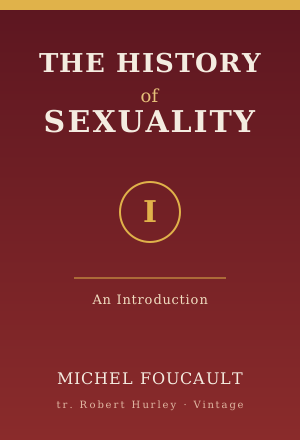
- The History of Sexuality, Vol. 1: An Introduction
- Author
- Michel Foucault
- Translator
- Robert Hurley
- Publisher
- Vintage Books (1990 reissue)
- Length
- Major work · ~168 pp.
- Difficulty
- Advanced ★★★ — short, but densely argued
Check price & availability on the Amazon product page
What it is — in three lines
The slim first volume of a projected multi-book history, and the one that lays down the method. Foucault challenges what he calls the "repressive hypothesis" — the comfortable belief that the Victorians locked sex away and that our era has been bravely setting it free. Instead he traces how, from the seventeenth century on, sex became something to be confessed, classified, measured and endlessly discussed, until it was made central to who we think we are.
The core — from repression to production
The book's decisive move is to stop thinking of power as something that only says "no." Where the standard story imagines a lid pressed down on a natural drive, Foucault sees a vast machinery that produces — that incites talk about sex, sorts people into types, and attaches identities to desires. And he links this to a larger shift in what power is for. Older sovereign power was the right to take life; modern power, he argues, is increasingly the management of life — birth rates, health, populations, bodies — a form he names "biopower." Sexuality sits exactly where the discipline of the individual body meets the government of whole populations, which is why so small a book has cast so long a shadow across gender studies, queer theory and the politics of health. Read after Discipline and Punish, it feels like the same analysis of power turned toward life itself.
Three highlights
1. The "repressive hypothesis," dismantled
The reversal is genuinely startling on first reading: the very idea that we are "liberating" a repressed sexuality turns out to belong to the machinery it thinks it is escaping.
2. "Biopower"
The book's most far-reaching concept — power as the administration of life — has become basic vocabulary far beyond Foucault studies, from bioethics to political theory.
3. Short enough to reread
At around a hundred and fifty pages it is one of Foucault's most concentrated statements, and it rewards a second pass more than almost anything else on this shelf.
What to watch out for
Two honest notes. First, "short" is not "easy": the prose is compressed, and the argument assumes you are ready to give up the intuitive picture of repression — which is exactly why this shelf places it after the flagship, not before. Second, this is Volume 1 of an unfinished project; the later volumes turn to the ancient world and the ethics of the self and read quite differently, so do not expect this book to "conclude" the history it opens. Take it as the pivot from the middle-period Foucault of power to the late Foucault of the self.
Check price & availability on the Amazon product page