Home › Top 5 › Discipline and Punish
Review: Discipline and Punish — how society learned to rule by watching
★★★★★5.0 / 5.0 (editorial rating)
Verdict: if you read only one Foucault, read this. From the cruel spectacle of public execution to the quiet work of "discipline" and surveillance — the book that shows how the modern age set about making bodies docile and useful. The image of the Panopticon, where the few can watch the many, lights up our own world of cameras and self-monitoring without a word of adjustment. Of the major works it is the most gripping and the easiest to finish.
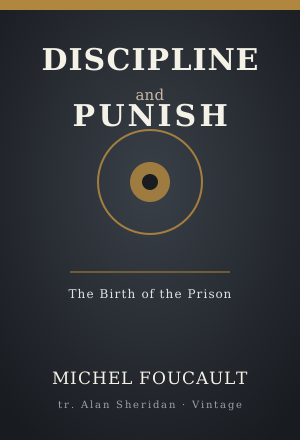
- Title
- Discipline and Punish: The Birth of the Prison
- Author
- Michel Foucault
- Translator
- Alan Sheridan
- Publisher
- Vintage Books (2nd Vintage ed., 1995)
- Length
- Major work · ~333 pp.
- Difficulty
- Intermediate ★★☆ — a major work, but the most readable one
Check price & availability on the Amazon product page
What it is — in three lines
The book opens with a question: why, over roughly a single century, did punishment shift from breaking the body in public to reforming the soul in private? Foucault sets two scenes side by side — the gruesome public dismemberment of a man who attacked the king, and, a few decades later, the minute-by-minute timetable of a reformatory for boys — and makes the reader feel the strangeness of that gap before he explains it. The prison is where the change is examined at its purest.
The core — power that reaches the body
What Foucault describes is not power that commands from above, but power that lives in the details and slowly shapes the body into something obedient and useful. Timetables, ranks, drills, examinations, records — the shared techniques of the school, the army, the factory and the hospital — he gathers under one word: discipline. Its emblem is the Panopticon, Bentham's design for a circular prison in which a single watcher in the central tower can see into every cell, while no prisoner can see the watcher. Not knowing when he is observed, the prisoner comes to police himself. Surveillance begins to work even when no one is watching — and that insight is what lifts the book out of penal history and into a theory of modern life. Once you have it, workplace metrics, attendance logs and the mutual watching of social media all start to look like the same machine.
Three highlights
1. The opening contrast you never forget
The scaffold and the timetable, placed back to back. The very structure of those first pages teaches the argument through the body before a single concept is named; you feel the uncanniness of the change before you understand it.
2. A tool you can carry out of the book
Once you have the lens of "discipline," your own workplace and school look different. Appraisal systems and daily reports rise up as techniques for making people, and the book's concepts become instruments for analysing your own days.
3. A clear line to the present
The discussion of the Panopticon is the starting point of nearly every modern argument about the surveillance society. After this, when the phrase turns up in the news, you can trace it back to its source in your own words.
What to watch out for
Two honest notes. First, it is a full-length major work, and there are stretches of detailed historical description; keep the overall arc (punishment → discipline → surveillance) in view by using the chapter headings as a map. Second, this is the doorway to Foucault's middle-period work on power, whose method differs from the early "archaeologies" such as The Order of Things. Read this most approachable book first to earn the feeling of "I can read Foucault," and only then move on to the harder early works.
Check price & availability on the Amazon product page