Home › Top 5 › Very Short Introduction
Review: Foucault — A Very Short Introduction — the map before the climb
★★★★☆4.6 / 5.0 (editorial rating)
Verdict: the ideal first book. Gary Gutting, one of the leading Anglophone readers of Foucault, gives you a short, honest map of a difficult thinker — not a slogan, but a guided tour of the problems Foucault kept circling: madness, knowledge, power, the self. Read this and the major works stop looking like a wall of jargon and start looking like a set of questions you can follow.
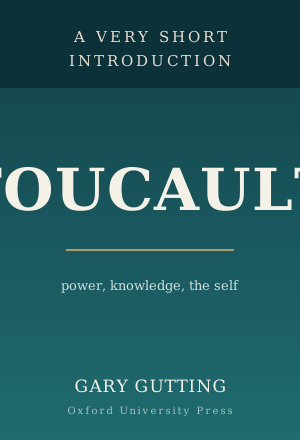
- Title
- Foucault: A Very Short Introduction
- Author
- Gary Gutting
- Publisher
- Oxford University Press (2005)
- Length
- Introduction · 144 pp.
- Difficulty
- Beginner ★☆☆ — the gentlest entry point
Check price & availability on the Amazon product page
What it is — in three lines
Part of Oxford's well-known "Very Short Introduction" series, this is a hundred-and-forty-page overview of Foucault by a philosopher who has written full scholarly books on him. Rather than march through the biography in order, Gutting organises the tour around the questions Foucault returned to across his career, showing how the famous books answer them. It is designed to be read before, not after, the primary works.
The core — problems, not a formula
Gutting's opening move is a refusal: he will not hand you a one-sentence "theory of Foucault," because there isn't one, and pretending otherwise is how readers get lost. Instead he takes the recurring problems — how a society decides who counts as mad or sane, how bodies of "knowledge" get built and policed, how power works not by forbidding but by producing, and how we come to be the kind of selves we are — and shows Foucault working on each. The reward is a thread you can hold: when you later open Discipline and Punish or The History of Sexuality, you already know which question the book is trying to answer, and the difficulty stops being disorienting. Gutting is also candid about the criticisms Foucault has drawn, so you get a map with the rough ground marked, not a fan's brochure.
Three highlights
1. It makes the vocabulary land
Terms like episteme, discipline and biopower are introduced where they belong — inside the problem they were coined to solve — so they stick as ideas rather than as words to be memorised.
2. Genuinely short
A couple of hours, pocket-sized. You can read it on the train before starting a major work and immediately feel steadier on the ground.
3. Balanced, not worshipful
Gutting sets out the standard objections to Foucault as well as the achievements, which is exactly what a first-time reader needs in order to think rather than just absorb.
What to watch out for
Two honest notes. First, a map is not the territory: this book tells you about Foucault, and it is no substitute for reading him. That is why this shelf pairs it with The Foucault Reader, so you meet the actual prose early. Second, it is a scholar's introduction, written with real intellectual seriousness — accessible, but not a picture-book; expect to think. Read it as the map for the climb, then start climbing.
Check price & availability on the Amazon product page