Home › Top 5 › The Foucault Reader
Review: The Foucault Reader — Foucault in his own words, curated
★★★★☆4.4 / 5.0 (editorial rating)
Verdict: the antidote to reading about Foucault instead of reading him. Paul Rabinow, who knew and worked with Foucault, assembles extracts, essays and interviews spanning the whole career into one manageable volume. It is far easier to meet Foucault's own prose in short, chosen pieces than to be defeated by a whole treatise — and this is the book that lets you do it.
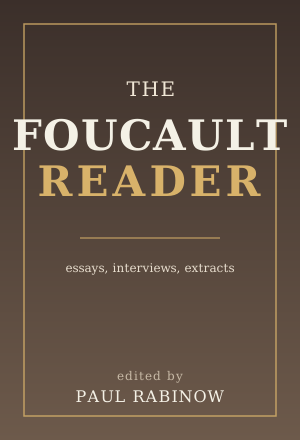
- Title
- The Foucault Reader
- Author
- Michel Foucault
- Editor
- Paul Rabinow
- Publisher
- Pantheon Books (1984)
- Length
- Anthology · ~400 pp.
- Difficulty
- Intermediate ★★☆ — short pieces, real substance
Check price & availability on the Amazon product page
What it is — in three lines
A single-volume anthology of Foucault's own texts, chosen and arranged by the anthropologist Paul Rabinow. It gathers extracts from the major books, stand-alone essays, and interviews in which Foucault explains himself in plain terms, and it moves across the full sweep of his work — from the archaeology of knowledge through discipline and power to the late writing on ethics and the self. It was prepared with Foucault's cooperation late in his life.
The core — the whole career in one volume
The Reader's great virtue is that it lets you taste every phase of Foucault without swallowing a whole book from each. You get the argument of the archaeologies in compact form, a famous discussion of the Panopticon drawn from Discipline and Punish, the opening of the sexuality project, and — a highlight for many readers — the essay "What Is Enlightenment?", where Foucault reflects on Kant and on what it means to think critically about one's own present. The interviews are especially valuable: pressed by a questioner, Foucault often states in a paragraph what a book takes a hundred pages to build. Read alongside an introduction, the Reader keeps you honest — you are never mistaking someone's summary for the thing itself, because the thing itself is right there on the page, in short enough stretches to finish.
Three highlights
1. "What Is Enlightenment?"
One of Foucault's most accessible and quoted essays, and a fine place to feel how his mind actually moves — turning a historical question into a question about our own moment.
2. The interviews
Foucault was a superb explainer of himself when questioned. The interview selections give the major concepts in unusually direct language.
3. Coverage without commitment
Early, middle and late Foucault in one book, so you can find out which period pulls you before you invest in a full-length work from it.
What to watch out for
Two honest notes. First, an anthology gives you chosen extracts, not whole arguments: an excerpt from a major work is a taste, and the full book still rewards reading in its own right. Second, note the editions — the long-standing Pantheon paperback reviewed here is the classic compilation; a later reissue exists with different pagination, and the closely related Essential Works volumes cover similar ground at greater length. For a first single volume of Foucault's own words, this remains the standard choice. Read it with the introduction, not instead of a major work.
Check price & availability on the Amazon product page