CAMUS BOOK GUIDE
The 5 Best Albert Camus Books (2026)
— from The Stranger to The Rebel, in reading order
Almost everyone comes to Camus for one idea — "the absurd" — and almost everyone starts in the wrong place. Camus wrote in three registers at once: novels, philosophical essays, and political argument, and the good news is that the door is a short novel you can read in an afternoon. Meet the absurd first as a feeling in The Stranger, watch it answered by solidarity in The Plague, and only then take it apart as an idea in The Myth of Sisyphus. Five books, in an order that actually works.
The editorial room behind this site runs a family of philosopher bookshelves and a section-by-section reading archive of the primary texts (in Japanese) — a Japanese edition of this Camus shelf is maintained alongside sisters such as The Nietzsche Bookshelf. Every recommendation rests on first-hand reading, and every page here is honest about one thing: Camus disliked being called an existentialist, and "the absurd" is a starting point in his work, not a conclusion.
Our RankingRANKING
The editorial order. If you can't decide, start at #1. Check prices and availability on the Amazon product pages.
-
1
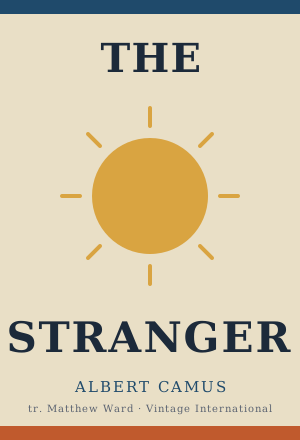 If in doubt, start hereBeginner–Intermediate
The Stranger
The single best entry point: a short, plain-spoken novel about Meursault, a man who will not pretend to feel what he does not — and is condemned as much for that as for the killing on a sun-blinded Algerian beach. You close it unsettled, holding the exact feeling Camus called "the absurd." If you read only one Camus, read this one.
Check price & availability on Amazon / Kindle edition available
View on Amazon Read on Kindle Read our review -
2
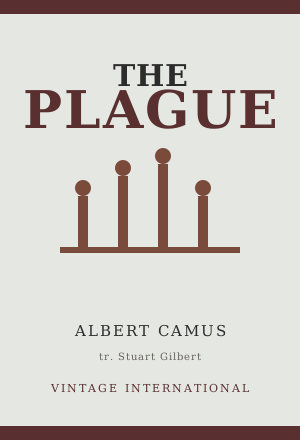 Intermediate
The Plague
A city sealed off by an epidemic, and Dr Rieux, who neither flees nor plays the hero but simply keeps working at his post. Written as an allegory of the Nazi occupation, it is Camus's richest answer to the absurd: not despair, but the plain decency of doing your job in the face of a disaster no one deserves. The novel where his idea of revolt becomes a story.
Check price & availability on Amazon
View on Amazon Read our review -
3
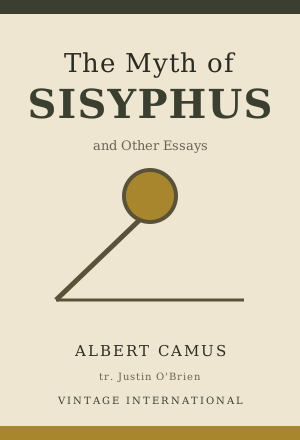 Advanced
The Myth of Sisyphus and Other Essays
"There is but one truly serious philosophical problem, and that is suicide." From that opening line, Camus turns the absurd from a feeling into an argument: if life has no given meaning, is it still worth living? His answer — yes, without appeal, without hope — reaches its image in Sisyphus, condemned to roll his rock forever, whom we must imagine happy. The theoretical spine of everything else on this shelf.
Check price & availability on Amazon
View on Amazon Read our review -
4
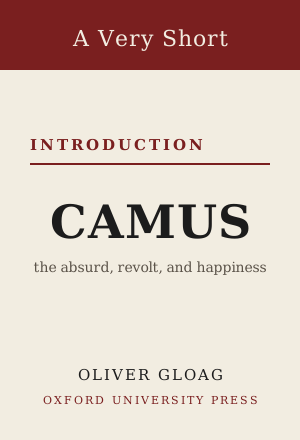 Beginner
Albert Camus: A Very Short Introduction
Once you have read a novel or two, this is the scholar's short map: the life from poverty in French Algeria to the Nobel Prize and the early death, the major works, and the arguments that still surround Camus — including the debate over colonialism and his silence on Algerian independence. A hundred and forty honest pages that place the books in a whole life.
Check price & availability on Amazon / Kindle edition available
View on Amazon Read on Kindle Read our review -
5
 Advanced
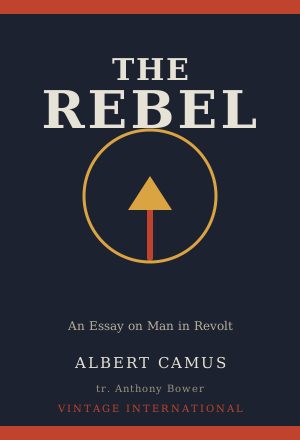
The Rebel: An Essay on Man in Revolt
The sequel to Sisyphus, and the book that ended his friendship with Sartre. If the absurd throws us back on ourselves, what do we do? Camus's answer is revolt — "I rebel, therefore we exist" — but a revolt with limits, one that refuses the murder and terror that revolutions so easily excuse. His most demanding and most argued-over book, and the natural place to go further.
Check price & availability on Amazon / Kindle edition available
View on Amazon Read on Kindle Read our review
The 5 Books at a GlanceCOMPARE
The two forks in choosing your first Camus: "novel or essay?" and "how much do I want the whole life behind the books?" Choose by difficulty and type.
| Title | Difficulty | Length | Type | Best for | Links |
|---|---|---|---|---|---|
| The Strangertr. Matthew Ward · Vintage International | Beginner–Intermediate ★★☆ | ~144 pp. ~3 hrs |
Novel (flagship) | Your one book, if you read only one Camus | View on Amazon Review |
| The Plaguetr. Stuart Gilbert · Vintage International | Intermediate ★★☆ | ~320 pp. ~9 hrs |
Novel | The absurd answered by solidarity and decency | View on Amazon Review |
| The Myth of Sisyphustr. Justin O'Brien · Vintage International | Advanced ★★★ | ~212 pp. 1–2 weeks |
Philosophical essays | The absurd as an argument, not just a mood | View on Amazon Review |
| Camus: A Very Short IntroductionOliver Gloag · Oxford University Press | Beginner ★☆☆ | ~144 pp. ~4 hrs |
Scholarly introduction | The whole life and the debates, in one map | View on Amazon Review |
| The Rebeltr. Anthony Bower · Vintage International | Advanced ★★★ | ~320 pp. 2–3 weeks |
Philosophical essay | Going further: revolt, and its limits | View on Amazon Review |
Novel or essay first? Start with the novels. The Stranger makes you feel the absurd; The Myth of Sisyphus then explains it. Reading the essay cold, before the novel, is the most common way to bounce off Camus — so let the story do the teaching first.
A Reading Order That Won't Defeat YouROADMAP
The usual mistake with Camus is starting with the theory — opening The Myth of Sisyphus first and drowning in Kierkegaard and Husserl on page ten. Instead: feel the absurd in a novel, watch it answered by another, then take it apart as an idea, and finish with the whole life. Climb in four steps.
-
STEP 1 ── Feel the absurd (one book)
Read The Stranger first
Before any theory, the feeling. A short, transparent novel in which a man's refusal to perform the expected emotions slowly turns the whole world against him. Read it in an afternoon; the unease it leaves behind is the absurd, and every later book explains that unease.
The Stranger on Amazon -
STEP 2 ── See it answered (the second novel)
The Plague — from the absurd to solidarity
If the absurd is real, what do you do about it? Camus's answer, dramatised: a sealed city, an epidemic, and people who keep working at their posts without illusions or heroics. This is where his idea of revolt stops being abstract and becomes the plain decency of Dr Rieux. Read it while The Stranger is still fresh.
The Plague on Amazon -
STEP 3 ── Take it apart (the hard climb)
The Myth of Sisyphus — the absurd as an idea
Now the theory, and now it will land. Having felt the absurd in two novels, you can follow Camus as he argues that a meaningless life can still be lived fully — without suicide and without false hope. The hardest book on this shelf, but the earlier steps make the abstract argument click into place: "so that is what the feeling was."
The Myth of Sisyphus on Amazon -
STEP 4 ── See the whole life (the goal)
Gloag's Very Short Introduction to tie it together
Finish by placing the books in a life — the poverty in Algeria, the Resistance, the Nobel Prize, the quarrel with Sartre, the early death, and the hard questions about colonialism that Camus's work still raises. Reach this point and the shelf has done its job. Want to go further? The Rebel takes revolt to its political limits, and The Fall is the great late novel.
Very Short Introduction on AmazonThe Rebel on Amazon
How We ChoseCRITERIA
Three criteria. First, currently in print and actually available on amazon.com — every title has a live product page from an established publisher (Vintage International for the four Camus texts, Oxford University Press for the study). Second, the ladder must hold: feel the absurd (The Stranger) → see it answered (The Plague) → take it apart (The Myth of Sisyphus) → place it in a life (the Very Short Introduction), with The Rebel as the advanced next step. Third, honesty about what each book is: a novel is not a thesis, an essay is an argument you can push back on, and Camus is a contested figure — an anti-colonial voice to some readers and, on Algeria, a disappointing silence to others. The reviews say so, and the study we chose puts that debate front and centre. The editorial room runs a family of philosopher bookshelves and a section-by-section archive of the primary texts (in Japanese); those first-hand readings are the foundation here.
Still Undecided? Take This OneCONCLUSION
If you have read this far and still can't choose, the answer is simple: buy The Stranger. It is short, it is plain, and it delivers the whole of Camus's core idea as an experience rather than a lecture — one paperback, one afternoon, and the exact feeling the rest of his work spends decades explaining. Feel the absurd there first; then The Plague for the answer and The Myth of Sisyphus for the theory. That is the route this shelf recommends.
Check price & availability on the Amazon product pages