Review: The Plague — the absurd, answered by solidarity
★★★★★4.6 / 5.0 (editorial rating)
Verdict: the novel where Camus's philosophy becomes an ethics you can watch in action. A sealed city, an epidemic, and a doctor who simply keeps working — no heroics, no despair, only the stubborn decency of doing your job against a disaster no one deserves. The best second Camus, and for many readers the one that stays.
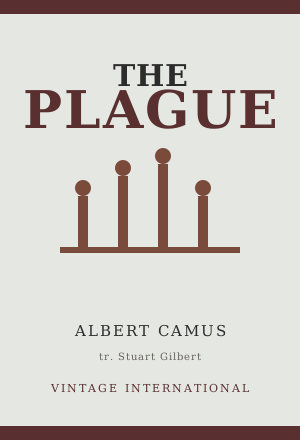
- Title
- The Plague
- Author
- Albert Camus, tr. Stuart Gilbert
- Publisher
- Vintage International (this tr.; original La Peste 1947)
- Length
- Novel · ~320 pp.
- Difficulty
- Intermediate ★★☆ — a full-length novel, but plainly told
Check price & availability on the Amazon product page
What it is — in three lines
Rats begin dying in the Algerian coastal town of Oran; soon the townspeople are dying too, and the gates are locked for months of quarantine. The narrator follows Dr Bernard Rieux and the volunteers who form around him — the visitor Tarrou, the clerk Grand, the journalist Rambert, the priest Paneloux — as each decides how to act inside a catastrophe with no meaning and no end in sight. Less a thriller than a study of how ordinary people behave when the world stops making sense, and of what "doing your job" comes to mean.
Why it belongs second
Because it is the answer to The Stranger. Where the first novel leaves you alone with the absurd, this one asks the next question — given a silent universe and an undeserved disaster, how should we live together? — and dramatises Camus's reply: not resignation, not false hope, but revolt in its humblest form, the refusal to accept suffering and the decision to fight it beside other people.
There's no question of heroism in all this. It's a matter of common decency. That's an idea which may make some people smile, but the only means of fighting a plague is — common decency.
— Albert Camus, The Plague (Dr Rieux)
Written just after the Occupation, the novel is also a deliberate allegory: the plague is the brown tide of fascism, and the volunteer sanitary squads are the Resistance. But Camus keeps the allegory loose enough that the book has read, in every decade since — and never more than recently — as a plain and durable account of life under any shared calamity.
Three highlights
1. Rieux — decency without heroics
The doctor is the moral centre precisely because he refuses grandeur. He does not know whether his work will win; he does it anyway, because the alternative is to consent to death. Camus's ethic of revolt has no better portrait.
2. The debate with Paneloux
When the priest preaches that the plague is God's punishment, and then watches a child die in agony, the novel stages its hardest argument — about suffering, innocence, and whether any meaning can be salvaged. Camus gives the believer real weight; he does not win cheap.
3. The narrator's quiet trick
The identity of the chronicler is held back and revealed late, turning the whole book, in retrospect, into an act of testimony — a promise to bear witness so that what the plague did, and what people did against it, is not forgotten.
What to watch out for
Two honest notes. First, it is longer and slower than The Stranger; the middle stretches deliberately convey the grinding sameness of quarantine, so read it for accumulation, not incident. Second — as with all of Camus's Algerian settings — the Arab majority of Oran is almost entirely absent from the page, a silence that later readers and critics have justly noted; Gloag's Very Short Introduction discusses exactly this. The book's humanism is real, and its blind spot is real; hold both.
Check price & availability on the Amazon product page