Home › Top 5 › A Very Short Introduction
Review: Albert Camus: A Very Short Introduction — the whole life, in one map
★★★★☆4.3 / 5.0 (editorial rating)
Verdict: the scholar's short map, and the honest one. A hundred and forty pages that place every book in a whole life — Algeria, the Resistance, the Nobel Prize, the early death — and, unusually, refuse to look away from the hard question of Camus and colonialism. The ideal book to finish the shelf on.
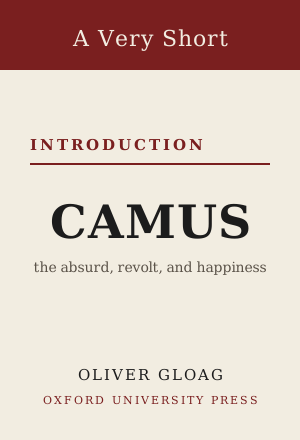
- Title
- Albert Camus: A Very Short Introduction
- Author
- Oliver Gloag
- Publisher
- Oxford University Press (2020)
- Length
- Scholarly introduction · ~144 pp.
- Difficulty
- Beginner ★☆☆ — clear, compact, and readable in an afternoon
Check price & availability on the Amazon product page
What it is — in three lines
Part of Oxford's long-running Very Short Introductions series, this is a compact guide to Camus's life and work by a scholar of French and Francophone studies. In around a hundred and forty pages Gloag moves from Camus's childhood in poverty in French Algeria through the major works — The Stranger, The Myth of Sisyphus, The Plague, The Rebel, The Fall — to the Nobel Prize, the break with Sartre, and the death at forty-six in a car crash. Throughout, it treats Camus as a figure to be understood in full, including his contradictions, rather than a saint to be admired.
Why it belongs at the finish
Because a map is most useful once you have walked some of the ground. Having read the novels and the essay, you can now see how the pieces connect — how the absurd of the early work becomes the revolt of the later, and how the life shaped both. And Gloag does something many introductions dodge: he puts the debate about Camus and colonialism at the centre, weighing Camus's real anti-fascism and opposition to the death penalty against his equivocation over Algerian independence.
That candour is the book's value. It gives you not a tidier Camus but a truer one, and it hands you the terms of the arguments — with Sartre, with the Algerian question, with the charge of a "philosophy for adolescents" — that you will meet everywhere else in the literature.
Three highlights
1. The life, compressed and clear
Poverty, tuberculosis, the Resistance newspaper Combat, sudden fame, the Nobel, the crash — Gloag lays out the biography efficiently enough that the books stop floating free and settle into a chronology.
2. The colonial question, faced head-on
This is the introduction's signature. Gloag neither cancels Camus nor excuses him; he lays out the evidence and the stakes so you can think about it yourself — the best possible service a short book can do.
3. A guide to the whole shelf
Because it covers works beyond our five — The Fall, the late stories, the plays — it doubles as a map of where to go after this reading list ends.
What to watch out for
Two honest notes. First, this is a secondary source, not Camus's own words — a map, not the territory. Read it after at least The Stranger, or it will spoil the pleasure of meeting the books fresh. Second, Gloag writes from a definite critical standpoint — sympathetic to the postcolonial critique of Camus — and while he is fair, another scholar would strike the balance differently. Take it as one well-argued view, not the last word; that is exactly how a good introduction should be used.
Check price & availability on the Amazon product page