Review: The Rebel — revolt, and its limits
★★★★☆4.2 / 5.0 (editorial rating)
Verdict: the demanding sequel to Sisyphus, and the book that cost Camus his friendship with Sartre. If the absurd throws us back on ourselves, what may we do about it? Camus answers: revolt — but a revolt with limits, one that refuses the murder and terror that revolutions excuse. His most argued-over work, and the natural place to go further.
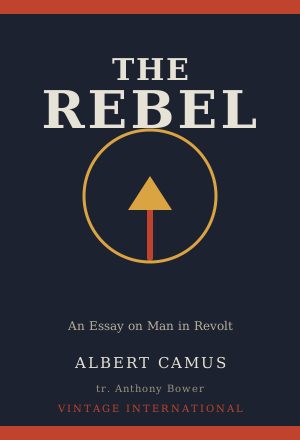
- Title
- The Rebel: An Essay on Man in Revolt
- Author
- Albert Camus, tr. Anthony Bower
- Publisher
- Vintage International (this tr.; original L'Homme révolté 1951)
- Length
- Philosophical essay · ~320 pp.
- Difficulty
- Advanced ★★★ — dense, historical, and polemical
Check price & availability on the Amazon product page
What it is — in three lines
If The Myth of Sisyphus asked whether life is worth living, The Rebel asks what we may legitimately do once we decide it is. Camus traces two centuries of "metaphysical" and "historical" rebellion — from Sade and the Romantics through the French and Russian revolutions to twentieth-century totalitarianism — to show how the just impulse to revolt keeps curdling into terror and mass murder when it grants itself no limits. His conclusion is a plea for revolt that remembers the value it began from: solidarity, moderation, and a refusal to sacrifice living people to a future idea.
Why it is the "go further" book
Because it is where Camus moves from the individual to the political, and where he pays for it. Read after the novels and Sisyphus, it completes the arc: the absurd (a fact) → revolt (a response) → revolt's limits (an ethics and a politics). Its most famous formula deliberately rewrites Descartes:
I rebel — therefore we exist.
— Albert Camus, The Rebel
The claim is that genuine revolt is never merely for oneself; it affirms a shared human dignity, and the moment it starts killing in the name of history it has betrayed itself. That argument — a frontal attack on the revolutionary violence many left intellectuals were then excusing — detonated on publication and led directly to Camus's bitter, permanent break with Sartre.
Three highlights
1. Revolt against revolution
Camus's central and most provocative move is to separate rebellion from revolution: the first says "no" in the name of a value, the second too often ends by justifying any means. It remains a live argument today.
2. The Sartre quarrel, in its source
Reading The Rebel lets you see exactly what the most famous falling-out in modern French thought was actually about — history, violence, and whether ends justify means — rather than the gossip version.
3. Moderation as courage
Against the glamour of extremes, Camus defends limit and measure — la mesure — as the hardest and bravest political virtue. An unfashionable case, argued with real force.
What to watch out for
Two honest notes. First, this is the most difficult book on the shelf — sweeping, allusive, and assuming familiarity with a century of European history and thought; do not attempt it as an early Camus. Second, it is a polemic, and a contested one: critics from Sartre's circle onward have charged that its history is selective and its politics quietist. Read it as a powerful argument to wrestle with, not a settled verdict — and let Gloag's Very Short Introduction supply the context for the fight it started.
Check price & availability on the Amazon product page