Home › Top 5 › The Myth of Sisyphus
Review: The Myth of Sisyphus — the absurd as an argument
★★★★☆4.4 / 5.0 (editorial rating)
Verdict: the theoretical spine of everything else on this shelf, and the one book here that genuinely earns its "Advanced" rating. It starts from suicide and ends with a happy Sisyphus — the essay in which Camus builds the absurd into a full argument. Read the novels first and it opens; read it cold and it can defeat you.
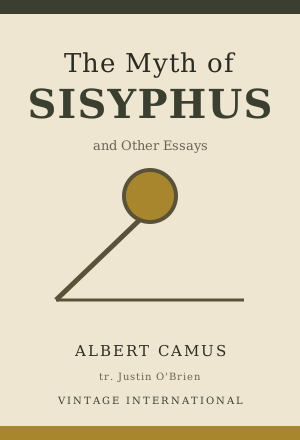
- Title
- The Myth of Sisyphus and Other Essays
- Author
- Albert Camus, tr. Justin O'Brien
- Publisher
- Vintage International (this tr.; original Le Mythe de Sisyphe 1942)
- Length
- Philosophical essays · ~212 pp. (title essay + others)
- Difficulty
- Advanced ★★★ — abstract, and steeped in earlier philosophers
Check price & availability on the Amazon product page
What it is — in three lines
Camus opens with the starkest possible question: given that life may have no meaning, why not simply end it? The essay refuses both suicide and the "leap" into religious or philosophical faith, and instead asks how to live with the absurd — the confrontation between our need for meaning and the world's silence — fully awake and without appeal. It closes with the figure of Sisyphus, condemned by the gods to roll a boulder uphill forever, reimagined as a hero of lucid defiance. The volume also gathers shorter essays, including the luminous "Summer in Algiers."
Why it belongs third, not first
Because this is where Camus argues, and the argument leans on Kierkegaard, Husserl, Dostoevsky and Nietzsche from the opening pages. Come to it cold and it can feel like a wall. Come to it having read The Stranger and The Plague, and the abstractions land on ground you already know — "so that is the feeling Meursault had," "so that is what Rieux was refusing." The famous conclusion is one of the most quoted lines in modern philosophy:
The struggle itself toward the heights is enough to fill a man's heart. One must imagine Sisyphus happy.
— Albert Camus, The Myth of Sisyphus, closing lines
It is not a counsel of despair but its opposite: if there is no meaning handed down, the meaning we make by living lucidly, and revolting against our condition rather than fleeing it, is ours and sufficient.
Three highlights
1. The opening move — suicide as the one serious question
By starting where he does, Camus forces the stakes into the open: this is philosophy asked as if your life depended on the answer, because he thinks it does. Nothing else on the shelf is quite so bracing to begin.
2. Refusing the "leap"
Against Kierkegaard's leap of faith and against nihilism alike, Camus insists on staying in the tension — neither resolving the absurd with God nor surrendering to it. Holding that middle is the whole discipline of the book.
3. Sisyphus reinterpreted
The final pages turn a punishment into an image of freedom: in the moment Sisyphus walks back down to his rock, conscious and unbroken, he is superior to his fate. It is the single most memorable page Camus wrote as a philosopher.
What to watch out for
Two honest notes. First, this is a young man's philosophy essay, not a system: its readings of Kierkegaard and Husserl are impressionistic, and professional philosophers have long argued that the logic is more literary than airtight. Read it for its force and its images, not as a proof. Second, do not start here. The single most common way to give up on Camus is to open this book first; the two novels are the on-ramp that makes it readable. If you find the middle sections heavy, skim to the Sisyphus essay and return.
Check price & availability on the Amazon product page