AUGUSTINE BOOK GUIDE
The 5 Best Augustine Books (2026)
— from the Confessions to the City of God, in reading order
Almost everyone who sets out to read Augustine stalls in the same two places: the abstract later books of the Confessions (memory, time, the reading of Genesis), or the sheer scale of the City of God, over a thousand pages long. But there is a staircase up. The difficulty is real, yet most of the falls come from trying to read a vast book cover to cover on the first day. Meet the man with a short introduction, feel the pull of his own voice in the Confessions, then climb toward the great works. This shelf ranks five books not by date of composition but by how readable they are and in what order they make sense — a map for not giving up.
The editorial room behind this site runs a family of philosopher bookshelves and a section-by-section reading archive of the primary texts — for example Heidegger's Being and Time (free, in Japanese). Every recommendation rests on first-hand reading, and the aim throughout is the same: to get the first book right, so you actually finish it.
Our RankingRANKING
The editorial order. If you can't decide, start at #1. Check prices and availability on the Amazon product pages.
-
1
 If in doubt, start hereIntermediate
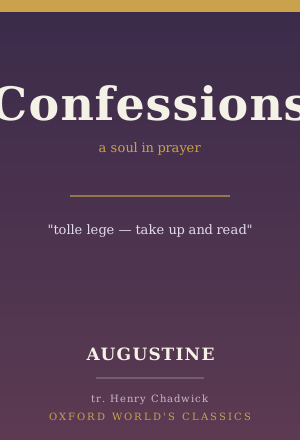
Confessions (Oxford World's Classics)
The West's first true autobiography, and still the one book to read if you read only one. A record of a soul — youthful appetite, the famous theft of pears, his mother Monica, and the garden in Milan where he hears a child's voice say "take up and read." Written throughout as a prayer addressed to God, it is the source of the modern sense of an inward "self." Chadwick's translation and notes are the scholarly standard.
Check price & availability on Amazon
View on Amazon Read our review -
2
 Beginner
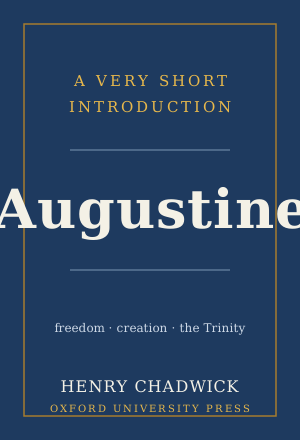
Augustine: A Very Short Introduction
The shortest reliable map of the whole man. In a hundred and forty pages, Chadwick — the leading English authority on Augustine — traces the road from a boy in Roman North Africa to the most influential thinker of Latin Christianity, with just enough on freedom, creation, and the Trinity to make the great works legible. The ideal thing to read before you open the originals.
Check price & availability on Amazon / Kindle edition available
View on Amazon Read on Kindle Read our review -
3
 Intermediate
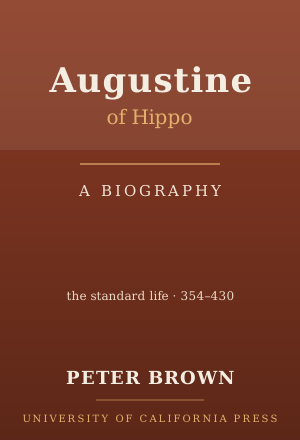
Augustine of Hippo: A Biography
The standard life, and one of the great biographies of any historical figure. Peter Brown sets Augustine inside the crumbling world of late Roman Africa and lets the man and his age illuminate each other. First published in 1967 and reissued with an epilogue reflecting newly discovered letters and sermons, it is where you go once the Confessions has made you want the whole story, not just the conversion.
Check price & availability on Amazon
View on Amazon Read our review -
4
 Intermediate
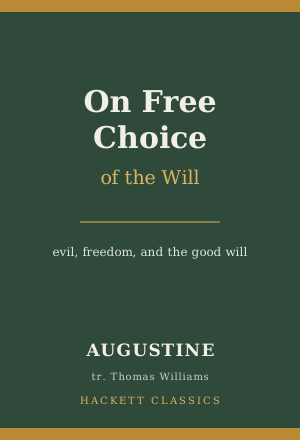
On Free Choice of the Will (Hackett Classics)
The philosophical Augustine, in a short dialogue you can hold in one hand. Where the Confessions is confession and the City of God is theology of history, this early work argues a hard question head-on: if God is good and all-powerful, where does evil come from? His answer — that evil is not a thing but a turning of the free will — shaped Western thinking about freedom and responsibility for centuries. Williams's Hackett translation is built for study.
Check price & availability on Amazon / Kindle edition available
View on Amazon Read on Kindle Read our review -
5
 Advanced
City of God (Penguin Classics)
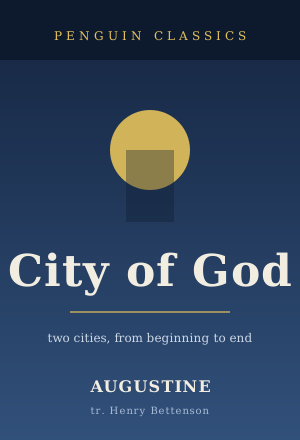
The life's work, begun after the sack of Rome in 410. Across twenty-two books Augustine sets two communities — the "earthly city" and the "city of God" — running through the whole of history, and builds a theology of history that shaped the Western view of society and the state. It is the summit of this shelf: unmatched in reach, and the most demanding by far. Bettenson's Penguin translation is the standard complete English text; take it on once the rest of the shelf has given you your footing.
Check price & availability on Amazon
View on Amazon Read our review
The 5 Books at a GlanceCOMPARE
The biggest worry with Augustine is "can I actually get through this?" Choose by difficulty and by type — a short introduction, a full biography, or one of the primary works.
| Title | Difficulty | Length | Type | Best for | Links |
|---|---|---|---|---|---|
| Confessionstr. Chadwick · Oxford World's Classics | Intermediate ★★☆ | ~380 pp. ~2 weeks |
Primary (autobiography) | Reading Augustine in one book; the conversion story | View on Amazon Review |
| Augustine: A Very Short IntroductionHenry Chadwick · OUP | Beginner ★☆☆ | 144 pp. ~3 hrs |
Scholarly introduction | The map of the whole man before the originals | View on Amazon Review |
| Augustine of Hippo: A BiographyPeter Brown · University of California Press | Intermediate ★★☆ | ~576 pp. 2–3 weeks |
Biography (the standard life) | The whole life and the late-Roman world | View on Amazon Review |
| On Free Choice of the Willtr. Williams · Hackett Classics | Intermediate ★★☆ | 160 pp. ~1 week |
Primary (dialogue) | The philosophical Augustine: evil and free will | View on Amazon Review |
| City of Godtr. Bettenson · Penguin Classics | Advanced ★★★ | ~1,184 pp. a long haul |
Primary (magnum opus) | The full theological reach; the two cities | View on Amazon Review |
A Reading Order That Won't Defeat YouROADMAP
People give up on Augustine for two reasons: trying to read a vast work like the City of God straight through, and trying to read the abstract later books of the Confessions (memory, time, Genesis) closely from the start. Introduction → flagship → deepen → magnum opus. Climb in four steps.
-
STEP 1 ── Stand at the door (one book)
Get the map with the Very Short Introduction
Don't dive into a primary text first. Spend an afternoon with Chadwick's short introduction and come away with the whole shape of the life and thought. With that map in hand, each book of the Confessions has somewhere to sit, and you won't get lost.
Very Short Introduction on Amazon -
STEP 2 ── Read the flagship (the heart of it)
Read the Confessions and get the "I can read this" feeling
On to the masterpiece. Read at least as far as the conversion in the garden and you will feel the heat of the man's mind — and the satisfaction of finishing a real book. The abstract later stretches on memory and time can be read lightly the first time through; you can always come back.
Confessions on Amazon -
STEP 3 ── Deepen (books 3–4)
Peter Brown for the life, On Free Choice of the Will for the philosophy
Once the Confessions has hooked you, widen out. Brown's biography gives you the whole life and its collapsing world; the short Hackett dialogue gives you the philosophical Augustine arguing where evil comes from. Read the biography for context and the dialogue for the reasoning behind the faith.
Peter Brown on AmazonOn Free Choice on Amazon -
STEP 4 ── The great work (the goal)
Take on the City of God
With your footing sure, climb the life's work. The two cities running through all of history is one of the load-bearing ideas of Western thought. It is the longest and hardest thing here, but after Steps 1–3 the difficulty turns from a wall into a climb worth making. Start at Book I and keep going. Reach the top and this shelf has done its job.
City of God on AmazonRead our review
How We ChoseCRITERIA
Three criteria. First, currently in print and actually available on amazon.com — every title has a live product page from an established publisher (Oxford University Press, University of California Press, Hackett, Penguin Classics). Second, the ladder must hold: a short introduction, then the flagship Confessions, then a full biography and a short philosophical dialogue, then the City of God — each step preparing the next, with an entry point at every height. Third, honesty about what each book is: an introduction is scaffolding, a biography is one historian's argued portrait, and a primary work is Augustine in his own words — and the reviews say which. Augustine has been read in many ways, in faith and in philosophy; this shelf does not push a single reading. It hands you the man's own text and a reliable map, and lets you judge. Every rating rests on first-hand reading and explicit bibliographic checking.
Still Undecided? Take This OneCONCLUSION
If you have read this far and still can't choose, the answer is simple: read the Confessions. It is Augustine's masterpiece and the West's first real autobiography, and the story of a soul turning toward what it was made for still holds readers sixteen hundred years on. If you would rather have the lie of the land before you start, spend an afternoon with the Very Short Introduction first — that is this shelf's recommended route.
Check price & availability on the Amazon product pages