Home › Top 5 › Peter Brown, Augustine of Hippo
Review: Peter Brown, Augustine of Hippo — the standard life
★★★★★4.7 / 5.0 (editorial rating)
Verdict: the biography, full stop — and one of the finest lives written of anyone. Peter Brown places Augustine inside the failing world of late Roman North Africa and lets the man and his age light each other up. First published in 1967, it effectively created the modern picture of Augustine; a later reissue adds an epilogue reflecting a remarkable trove of newly found letters and sermons. This is where you go once the Confessions has made you want the whole story, not just the conversion.
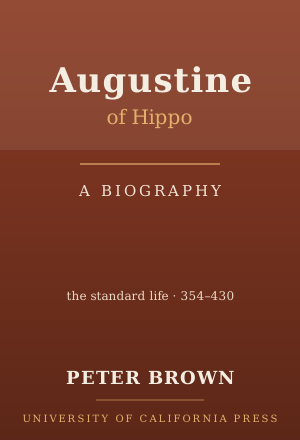
- Title
- Augustine of Hippo: A Biography
- Author
- Peter Brown
- Publisher
- University of California Press (New Edition, with an Epilogue)
- Length
- Biography · ~576 pp.
- Difficulty
- Intermediate ★★☆ — long, but narrative and readable
Check price & availability on the Amazon product page
What it is — in three lines
A full-scale life of Augustine by the historian who did more than anyone to shape how we read late antiquity. It follows the whole span — birth in the small town of Thagaste in 354, the career in rhetoric, the conversion, forty years as bishop of Hippo, the bruising controversies with Manichees, Donatists, and Pelagians, and death in 430 as the Vandals besieged the city. Above all it reads Augustine against his world: a Roman order visibly coming apart.
The core — the man inside his world
What lifts this above every other Augustine biography is that Brown refuses to treat his subject as a free-floating mind. He gives you a person embedded in a specific, vanishing society — its towns and estates, its patronage and letters, its quarrels over church and empire — and shows how the ideas grew out of the life and the pressures of the age. The Confessions tells you what Augustine made of his own inner history; Brown tells you what was happening around him while he made it, and what he became after the book everyone reads was written: an overworked bishop, a controversialist, an old man watching Rome fall. The result is not a summary of the doctrines but a portrait with argument in it — a historian's considered case about who this man was. That is what a great biography does, and few do it at this level.
Three highlights
1. Late antiquity made vivid
Brown practically invented "late antiquity" as a field, and it shows: the world of fourth- and fifth-century Africa comes alive, so that Augustine's decisions feel like real choices in a real place, not moves in a timeless system.
2. The whole life, not just the famous part
Most readers know Augustine only up to the conversion, because that is where the Confessions concentrates. Brown gives you the decades after — the bishop, the controversies, the old age — which are where much of the mature thought was forged.
3. The epilogue on new evidence
The reissue reckons with letters and sermons discovered after the first edition, which sharpened the picture of Augustine's first and last years. It is a rare chance to watch a classic biography update itself in the light of fresh sources.
What to watch out for
Two honest notes. First, this is a biography, not the primary text. It is a historian's portrait — deeply informed, but an interpretation, and Brown has his own emphases. Read it alongside Augustine's own words, not instead of them; that is why it sits at #3, after the Confessions. Second, it is long and it is a real work of history, with the density that implies — around 576 pages, assuming some appetite for the politics and controversies of the late Roman church. It is narrative and very well written, so it carries you along; but it is a step up in commitment from the introduction, and it rewards reading it after you already care about the man. Come to it once the Confessions has hooked you, and it reads like a door opening onto the rest of the story.
Check price & availability on the Amazon product page