Home › Top 5 › On Free Choice of the Will
Review: On Free Choice of the Will — where does evil come from?
★★★★☆4.4 / 5.0 (editorial rating)
Verdict: the philosophical Augustine, in a short dialogue you can hold in one hand. Where the Confessions confesses and the City of God builds a theology of history, this early work takes on one hard question directly: if God is good and all-powerful, where does evil come from? Augustine's answer — that evil is not a thing at all but a wrong turning of the free will — became one of the load-bearing ideas of Western thinking about freedom and responsibility. Williams's Hackett edition is made for study.
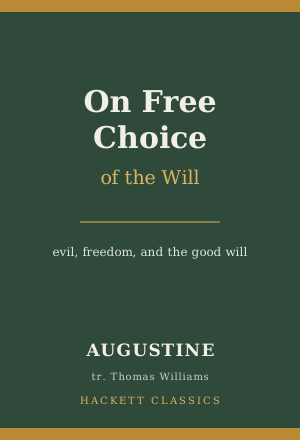
- Title
- On Free Choice of the Will (Hackett Classics)
- Author
- Augustine of Hippo
- Translator
- Thomas Williams
- Publisher
- Hackett Publishing Company (original: c. AD 388–395)
- Length
- Primary source · 160 pp.
- Difficulty
- Intermediate ★★☆ — short, but the argument is close
Check price & availability on the Amazon product page
What it is — in three lines
A dialogue in three books between Augustine and his friend Evodius, written not long after the conversion. Its driving question is the oldest hard problem of a good God's world: unde malum — where does evil come from? Rather than blaming a second, evil power (the answer Augustine had earlier taken from the Manichees), it locates the origin of moral evil in the created will's freedom to turn away from the good. Short, argued step by step, and foundational for everything he later wrote on freedom and grace.
The core — evil as a turning of the will
The book's central move is deceptively simple and hugely consequential. Augustine argues that evil is not a substance — not a thing God made, nor an equal dark power — but a privation, a falling-away: the free will choosing a lesser good over a greater, turning from God toward itself and lower things. This does two jobs at once. It clears God of authorship of evil, and it puts responsibility squarely on the free, rational creature: if the will is genuinely free, then its wrong turnings are its own. From here run the questions that occupied Augustine for the rest of his life — how free the will really is, how grace and freedom fit together — and much of later Western moral philosophy is a long argument with the position staked out here. To read it is to watch a foundational idea being built, in real time, out of a conversation.
Nothing can make the mind a slave to inordinate desire except its own will.
— Augustine, On Free Choice of the Will I (editorial gloss of the Latin)
Three highlights
1. A real philosophical argument, not a sermon
This is Augustine reasoning, question and answer, objection and reply. If you want to see him work as a philosopher rather than a memoirist or a theologian of history, this is the shortest clear window.
2. The problem of evil, head-on
The question — how a good, all-powerful God is compatible with evil — is still live in philosophy of religion today. Reading Augustine's version shows you where a whole tradition of answers begins.
3. Short and self-contained
At 160 pages it is by far the most manageable primary text on this shelf. You can read the whole argument in about a week and come away having actually finished a work of Augustine's philosophy.
What to watch out for
Two honest notes. First, short does not mean easy. The pages turn quickly, but the reasoning is close, and the third book in particular — on foreknowledge, will, and the origin of the soul — gets genuinely knotty; read it slowly and lean on Williams's notes. Second, a point of intellectual honesty that Augustine himself flagged: his own views on freedom and grace shifted over his lifetime. The strong emphasis on free choice here belongs to the younger Augustine; the later anti-Pelagian writings press much harder on the priority of grace, and he later re-read this very book in that light. So take it as the powerful opening statement of a lifelong argument, not as his last word — which is exactly what makes it such a good place to enter the philosophy.
Check price & availability on the Amazon product page