Review: City of God — the two cities, the life's work
★★★★★4.6 / 5.0 (editorial rating)
Verdict: the summit of this shelf, and Augustine's life's work. Begun after the shock of Rome's sack in 410, its twenty-two books set two communities — the "earthly city" and the "city of God" — running through the whole of history, and out of that grows a theology of history that shaped the Western understanding of society, the state, and time itself. It is unmatched in reach and, by a wide margin, the most demanding book here. Take it on last, once the rest of the shelf has given you your footing.
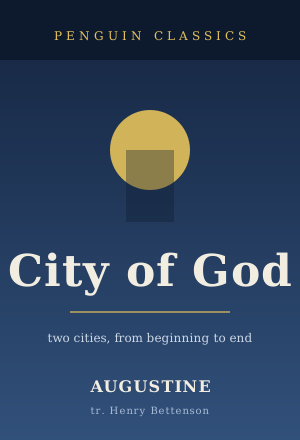
- Title
- City of God (Penguin Classics)
- Author
- Augustine of Hippo
- Translator
- Henry Bettenson
- Publisher
- Penguin Classics (original: AD 413–426)
- Length
- Primary source · ~1,184 pp. (complete, in one volume)
- Difficulty
- Advanced ★★★ — long, and the argument ranges wide
Check price & availability on the Amazon product page
What it is — in three lines
In 410 the Goths sacked Rome, and pagans blamed the disaster on the abandonment of the old gods for Christianity. The City of God is Augustine's enormous answer. The first ten books dismantle that charge — taking apart Roman religion and the claims of the classical philosophers; the later twelve build the positive case, tracing two "cities" — two communities defined by two loves — from the creation of the world to its end. It is at once apologetics, philosophy of history, political theology, and a summa of Augustine's mature thought.
The core — two cities, one history
The organizing idea is the two cities. Augustine argues that all of humanity belongs, invisibly, to one of two communities distinguished by what they love: the earthly city, built on love of self "even to the contempt of God," and the city of God, built on love of God "even to the contempt of self." These two are mingled throughout history and will only be separated at the end. With this single image he does something new and immensely influential: he decouples the fate of the true community from the fate of any earthly empire. Rome may fall; the city of God does not stand or fall with it. That move reframed how the West thought about the relation between religion and political power, about history as having a direction and an end, and about the limits of every earthly order. Whether or not you share Augustine's faith, this is one of the ideas the West was built around, and here is where it is worked out at full length.
Three highlights
1. A theology of history
Augustine treats history as a single story with a beginning, a middle, and an end — not endless cycles, but a line with meaning. The modern Western sense that history is going somewhere owes a great deal to this book.
2. The critique of Rome and the philosophers
The early books are a sustained, often mordant examination of Roman religion and of Greek and Roman philosophy — a fascinating record of late-antique Christianity arguing with the classical world it was inheriting and displacing.
3. The two loves
The definition of the two cities by their two loves is one of the most quoted formulations in Christian thought, and a genuinely powerful lens: communities, Augustine suggests, are constituted by what they love in common.
What to watch out for
Be honest about the scale: this is roughly 1,200 pages, and the argument ranges very wide — through Roman history, pagan cults, Platonist philosophy, scriptural exegesis, angelology, and eschatology. Two defences. First, come to it last, exactly as this shelf is arranged: after the introduction, the Confessions, the biography, and the short dialogue, you will have the context that makes the City of God navigable rather than bewildering. Second, you do not have to read every page in order to profit from it. Many readers take the great set-pieces — the opening books on the fall of Rome, and the later books where the two cities are defined and traced — and read more selectively through the long stretches of anti-pagan polemic. Use Bettenson's one-volume translation and its apparatus as a map, keep the two-cities idea in view as your thread, and treat finishing it as the goal it is. Reach the end and this shelf has done everything it set out to do.
Check price & availability on the Amazon product page